
Oak wood typically has a dried density of about 620 to 750 kg/m³ for many commonly used furniture species. That substantial weight is one reason oak furniture feels solid, stable, and built for daily use. But density is not simply a synonym for quality. Species, moisture content, grain structure, joinery, drying, and craftsmanship all influence how a finished piece performs.
Key Takeaways:
- Many common furniture oaks have dried densities of roughly 620 to 750 kg/m³, but species and moisture content can shift the number substantially.
- Density influences furniture weight and often correlates with hardness and strength, but it is not the same as hardness, strength, durability, or overall quality.
- The best oak wood furniture pairs suitable, properly dried hardwood with strong joinery, stable indoor conditions, and skilled craftsmanship.
What Is the Density of Oak Wood?
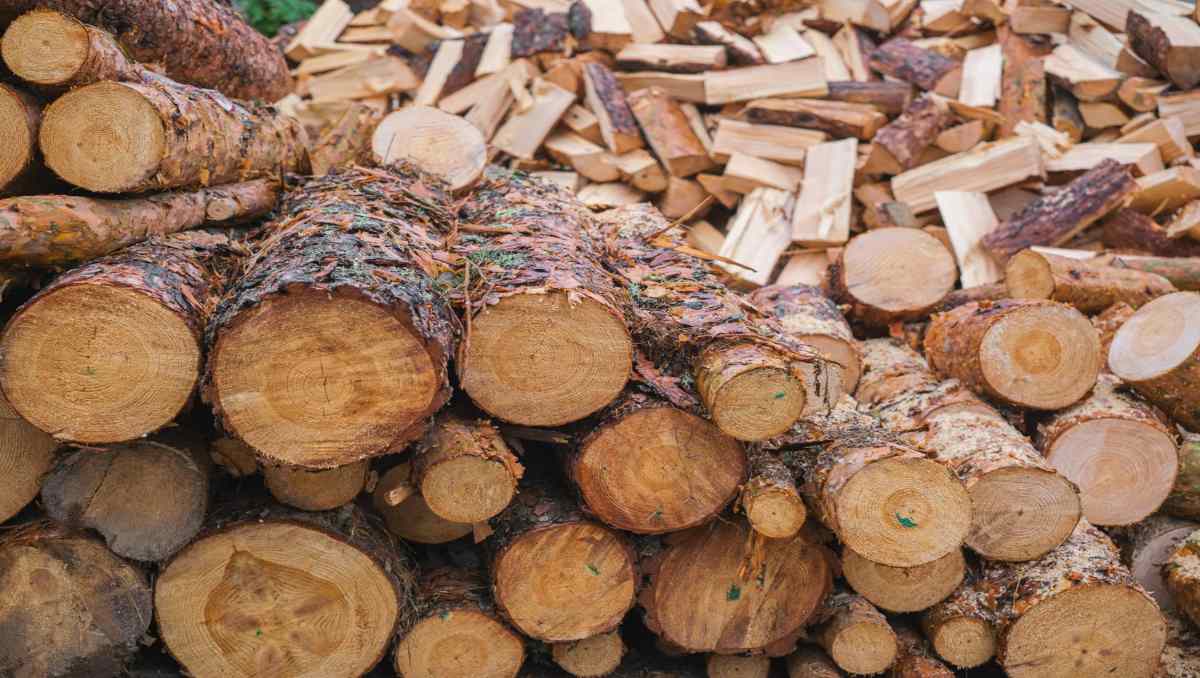
Wood density refers to how much mass is packed into a given volume of wood. It can give you a general idea of how heavy, hard, or durable a wood may feel, although density alone does not determine overall performance.
Oak is generally considered a medium-heavy to heavy hardwood. This means oak tends to feel substantial and solid compared with many lighter types of wood, which is one reason it is commonly used for furniture, flooring, cabinetry, and other applications where strength and durability are valued.
However, there is no single density that applies to all oak. Oak includes many different species, and the density of individual boards can vary. Factors such as moisture content, growth conditions, and the structure of the wood all play a role.
What Determines the Density of Oak Wood?
An oak board’s density is the result of both biology and moisture. Here’s what determines their overall density:
Oak Species
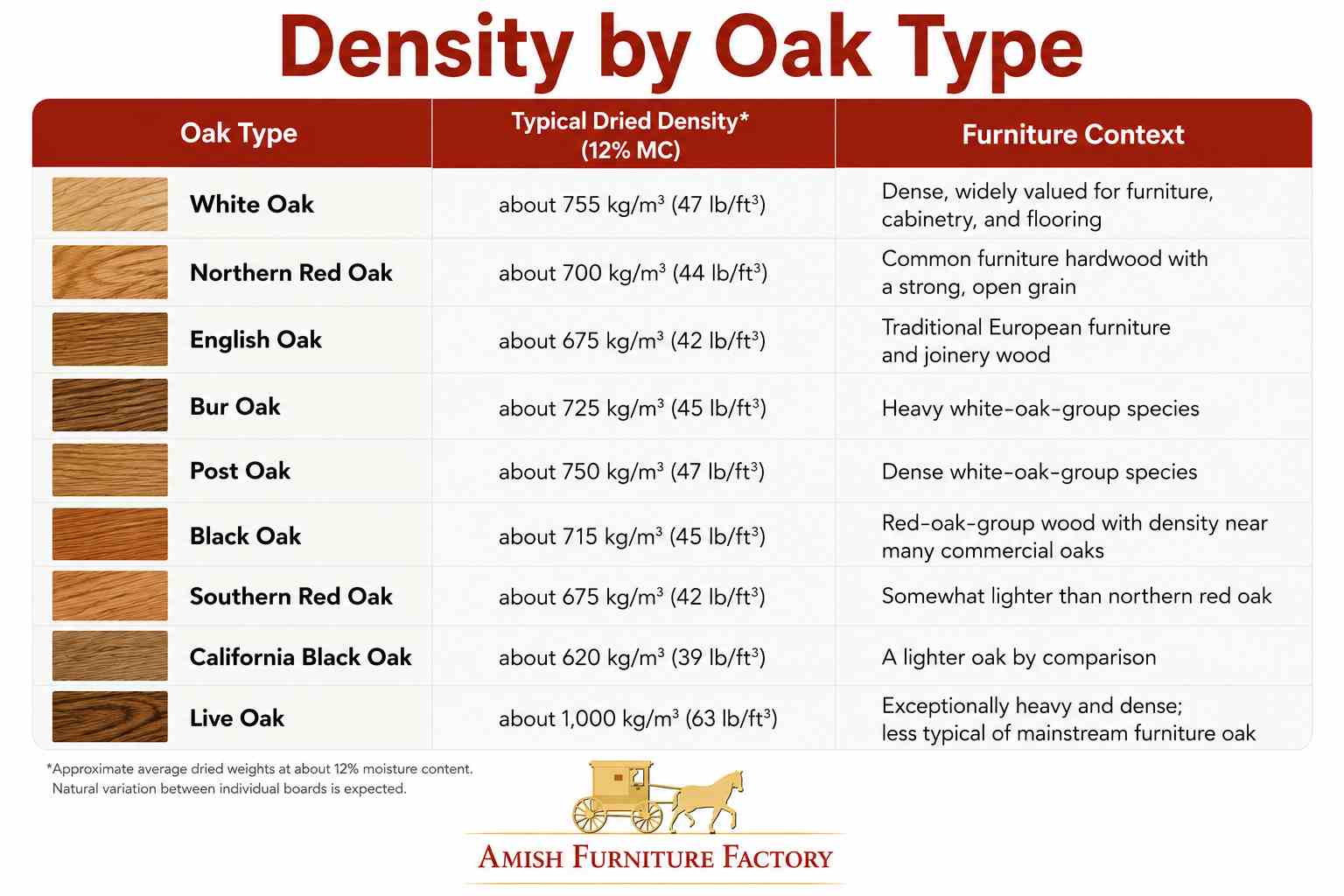
Commercial red and white oak groups contain multiple species, each with its own typical anatomy and specific gravity. Northern red oak, white oak, English oak, and live oak, therefore, should not be expected to have identical weights or mechanical and physical properties.
Here is a wood density chart by oak types:
Moisture Content
Wood is hygroscopic, meaning it exchanges moisture with the surrounding air. A freshly cut oak board contains far more water than properly dried furniture lumber and will weigh more. Even after kiln drying, wood continues to move toward equilibrium with indoor temperature and relative humidity. Density comparisons should therefore use a consistent moisture basis, such as the commonly referenced 12% moisture condition.
Growth Conditions and Tree Structure
Soil, climate, competition, growth rate, and the tree’s development affect the proportions and arrangement of wood cells. Ring structure and the balance of earlywood and latewood can change the amount of wood substance within a given volume.
Location Within the Tree
Wood taken from different heights and radial positions in a tree can vary in structure. Heartwood and sapwood also differ in function and composition, while juvenile wood near the center of a young stem can behave differently from mature wood.
Why Density Matters in Furniture Construction
Density affects how furniture feels, how the material responds to tools and fasteners, and how a piece carries everyday loads. It is best viewed as one part of a broader construction system rather than a stand-alone quality score. Here’s why it matters:
Weight and Stability
Dense oak adds physical weight. In a dining table, dresser, bed, or large cabinet, that oak mass can contribute to a planted, substantial feel and make the piece less easy to shift accidentally. The tradeoff is obvious: heavy oak furniture is more demanding to move, deliver, and reposition. Good design must also distribute that weight through properly proportioned legs, bases, rails, and joints.
Resistance to Everyday Wear
Density often correlates with hardness, so oak generally handles ordinary bumps and surface wear better than many lighter woods. Still, density alone does not make a tabletop damage-proof. Finish quality, Janka hardness, grain orientation, and the severity of an impact all matter. A dense oak surface can still scratch, dent, stain, or check if it is abused or exposed to unsuitable conditions.
Fastener and Joinery Considerations
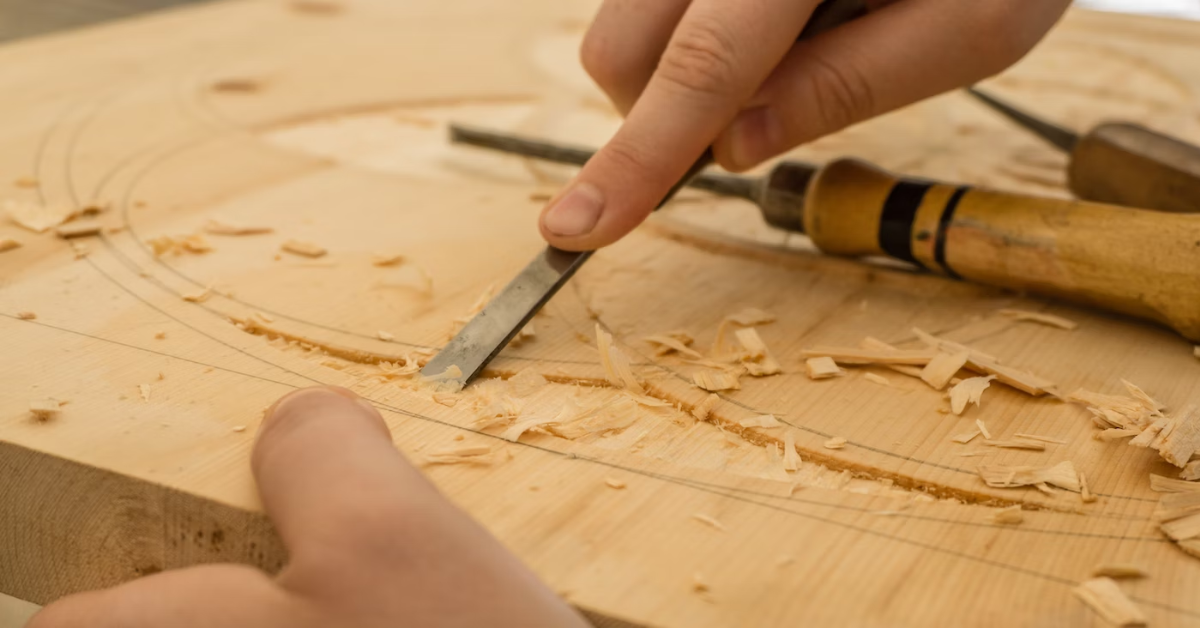
Dense hardwood lumber can hold screws and other fasteners effectively when the joint is designed correctly, but it also demands careful workmanship. Traditional furniture joints used by the Amish craftsmen such as mortise-and-tenon, dovetail, dowel, and properly engineered glued joints can take advantage of oak’s strength when they are accurately fitted and allow for normal wood movement. At Amish Furniture Factory, these traditional joinery methods are part of the construction approach used to create furniture designed for long-term everyday use.
Long-Term Structural Performance
Oak’s combination of density, stiffness, and strength makes it well suited to structural furniture components such as chairs, table bases, bed rails, and casework. Long service life, however, depends on more than the species. Proper drying, grain selection, joint design, hardware, finish, and craftsmanship determine whether the material’s potential is realized over decades of use.
Oak Furniture Selection and Care Guide
Density becomes most useful when it is translated into practical buying and care decisions.
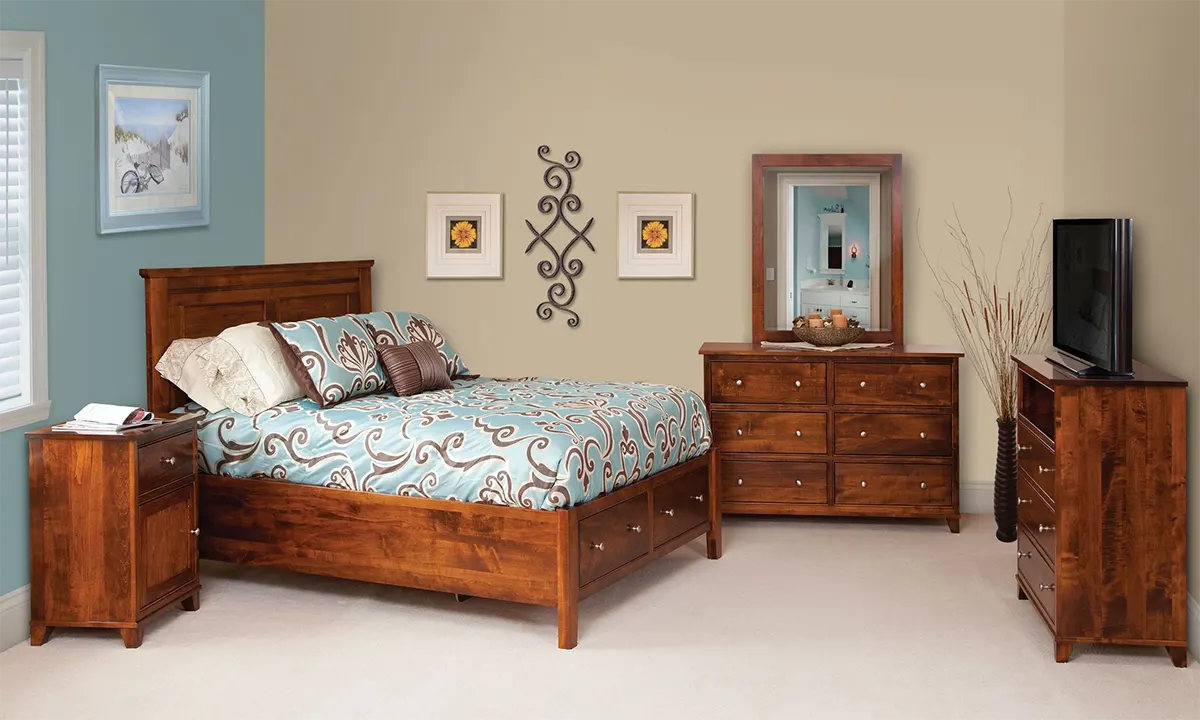
Spotting Solid Oak vs. Oak Veneer: Substantial solid-oak component often feels heavier than a similarly sized component made from a lighter substrate. Grain is another clue: on solid wood, end grain and face grain should relate naturally around edges, while veneer is a thin real-wood surface applied over a core.
Environmental & Room Placement: Keep solid oak away from persistent dampness, heating vents, radiators, and strong direct sunlight. Aim for reasonably stable indoor humidity rather than dramatic seasonal swings. We recommend controlling humidity around 40% to 45% for its solid-wood dining tables.
Long-Term Value Proposition: Evaluate cost per year rather than purchase price alone. A well-built solid-oak table that serves a household for decades can have a lower annual ownership cost than inexpensive furniture that must be replaced repeatedly.
Invest in a lifetime of sturdy shelving. Upgrade your home study with a solid oak bookcase built to hand down.
Conclusion: What Oak Density Means for a Better Furniture Choice
Oak wood density is a measure of mass per unit volume, and for many furniture-grade oak species it commonly lands in the neighborhood of 620 to 755 kg/m³ at about 12% moisture content. Density matters because it affects weight, machining, fastening, and often tracks with hardness and strength.
Looking for solid hardwood furniture built with those principles in mind? Explore Amish Furniture Factory’s oak and quarter-sawn oak furniture to compare styles, wood options, finishes, and construction choices for your home.
Frequently Asked Questions
How much does oak wood weigh?
It depends on species, volume, and moisture content. As a rough example, one cubic meter of dried northern red oak weighs about 700 kg, while one cubic foot is roughly 44 lb. A finished piece of furniture will weigh less or more depending on how much wood it contains.
What wood has the highest density?
Some of the densest commercially documented woods are tropical species such as lignum vitae and related very heavy hardwoods, with densities that can exceed that of water contents under standard dried conditions. The exact “highest” depends on species identification, specimen, and measurement method.
Does denser oak mean better-quality furniture?
No. Higher density can contribute to weight, hardness, and strength, but furniture quality also depends on drying, board selection, joinery, proportions, finish, hardware, and craftsmanship.
How does oak wood density affect the weight of furniture?
For pieces of similar size and construction, denser oak generally produces heavier furniture. That can create a substantial, stable feel, but it also makes the piece harder to move. Actual furniture weight depends on the amount of solid wood used and whether the design also includes veneer, plywood, MDF, metal, glass, or upholstery.
How does oak’s density compare with walnut, maple, cherry, and hickory?
Oak is generally denser than cherry and walnut, but slightly less dense than maple and hickory. White Oak is approximately 755 kg/m³, compared with roughly 640 kg/m³ for Black Walnut, 705 kg/m³ for Hard Maple, 560 kg/m³ for Black Cherry, and 830 kg/m³ for Hickory. These figures can vary by species and moisture content, but they provide a useful general comparison when evaluating hardwood furniture.