
Amish furniture vs factory made furniture often comes down to a trade-off between upfront cost and long-term value, with Amish-made pieces typically offering stronger craftsmanship, customization, and longevity. Factory-made furniture may be easier on the budget and quicker to replace, while Amish furniture is generally built with the expectation that it will stay in your home for many years. The gap in sticker price is real. What most buyers miss is what happens to each piece at year fifteen.
Key Takeaways
- Amish furniture is built from solid hardwood with dovetail and mortise-and-tenon joinery, so pieces can be repaired and refinished rather than replaced.
- Factory-made furniture costs less upfront, but quality varies widely. Construction and materials matter far more than the label on the tag.
- The decision between Amish and factory-made furniture depends on individual priorities, budget, and long-term goals.
What Makes Amish Furniture Different?
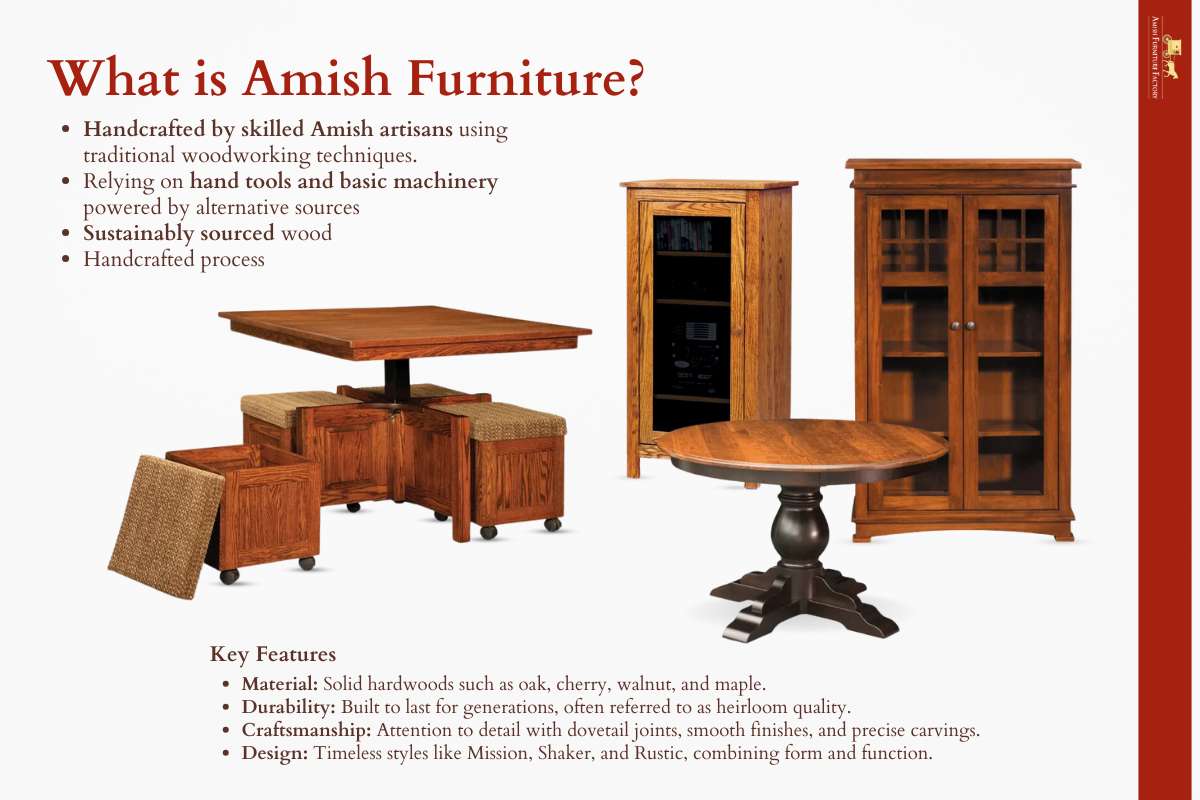
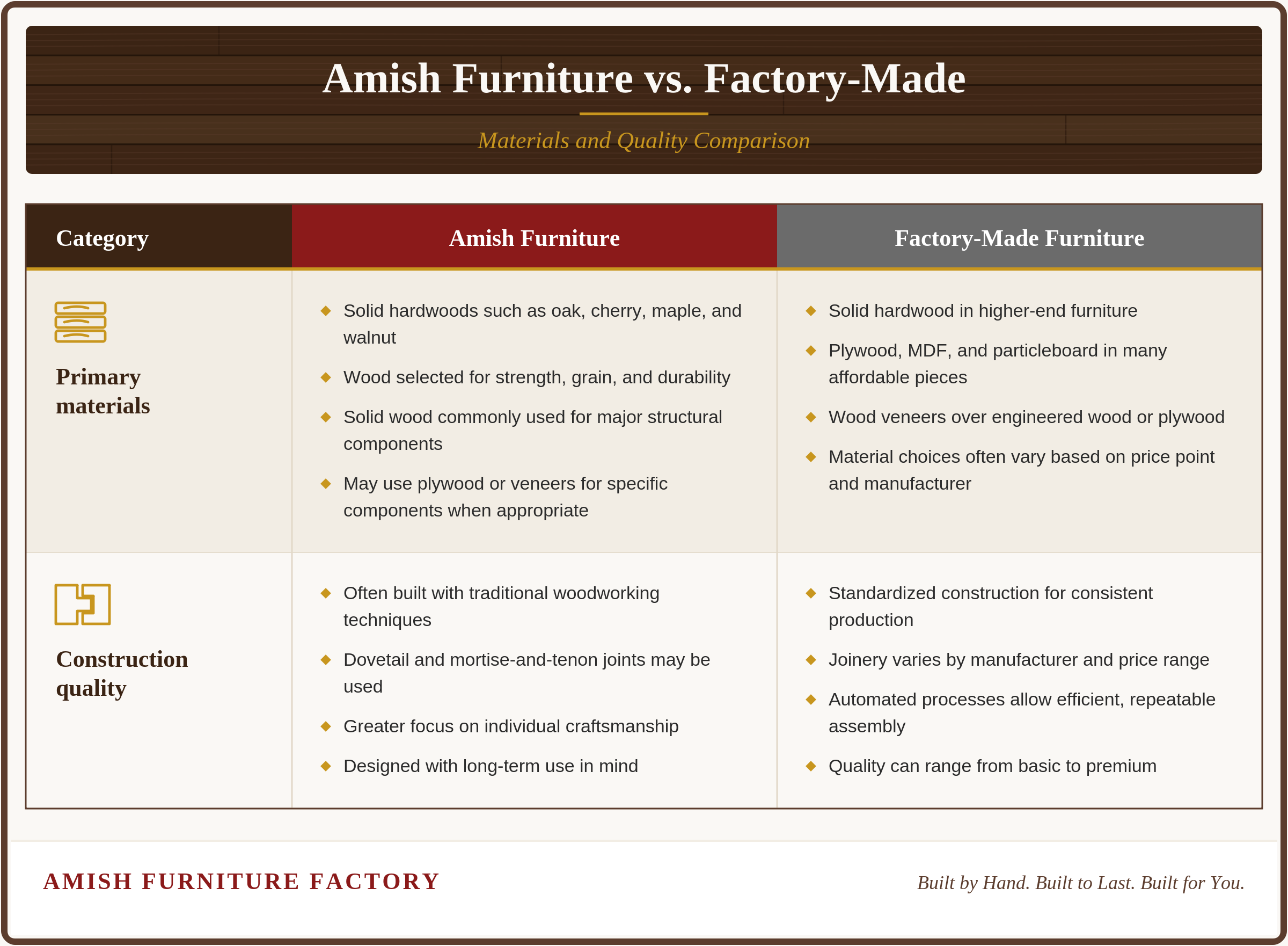
Amish furniture reflects a long-standing tradition of skilled woodworking and careful craftsmanship. Rooted in the Amish community’s values of simplicity and practicality, the tradition has been passed down through generations, with artisans using time-honored techniques such as dovetail joints and mortise-and-tenon construction. A mortise-and-tenon joint locks a table leg into the apron with a shaped tongue seated in a cut socket. No screws, no brackets. When the wood expands in summer humidity, the joint moves with it instead of loosening. Many pieces are made from solid hardwoods like oak, cherry, and maple, chosen for their strength, character, and natural beauty.
Overview of Factory-Made Furniture
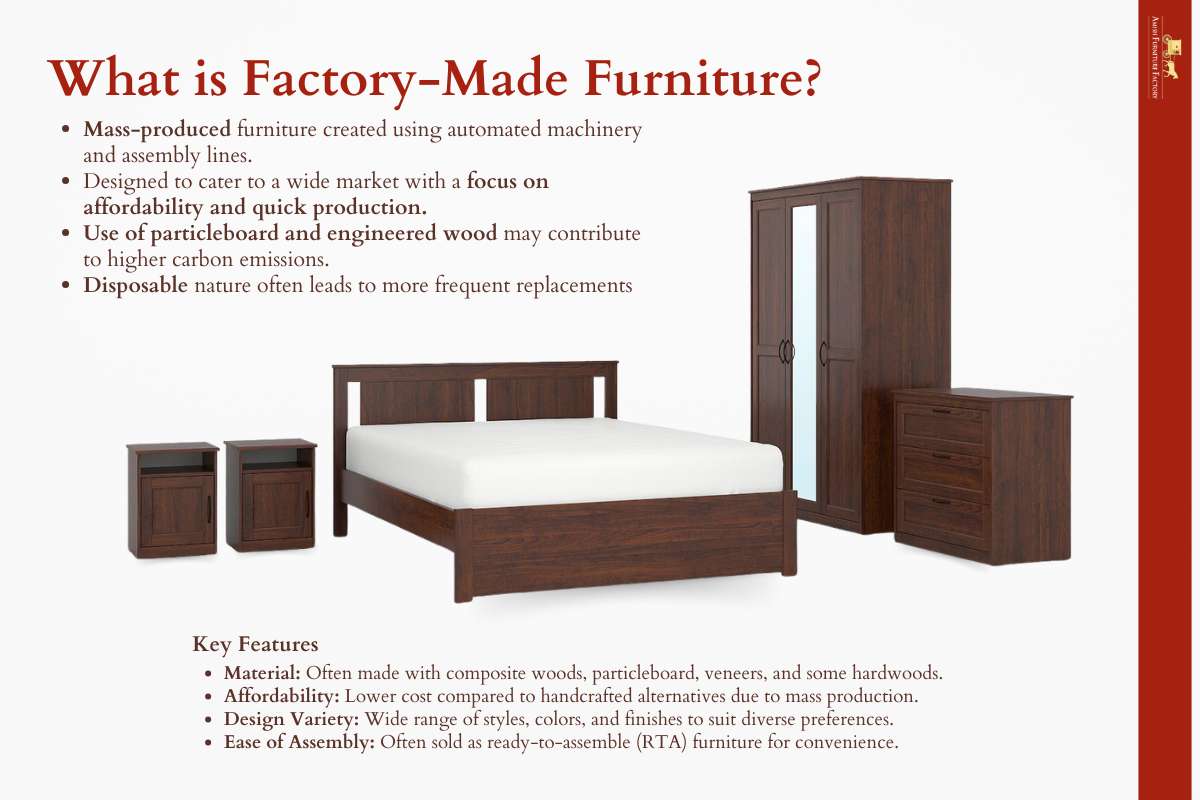
Factory-made furniture is designed around efficiency, consistency, and large-scale production. Modern manufacturing allows furniture to be produced quickly and in high volumes, making it widely available and often more affordable than custom-made alternatives. Materials can range from solid wood to engineered wood, particleboard, and veneers, depending on the manufacturer and price point. Now, mass production is not the problem. The materials usually are. A factory building to a $699 price point reaches for particleboard and a printed veneer because those are the only inputs that hit the number.
Quality and Materials
Amish furniture is commonly built from solid hardwoods such as oak, cherry, maple, and walnut, with the wood selected for its strength, grain, and ability to hold up to years of use. Factory-made furniture varies much more widely, with some pieces made from solid wood while others use plywood, MDF, particleboard, veneers, or combinations of these materials to balance cost, weight, and appearance. This does not mean factory-made furniture is automatically lower quality, since well-made factory furniture can still use durable materials and sound construction.
Price Comparison
A solid hardwood Amish dining table typically runs $1,500-$3,500, depending on wood species, size, and finish. A similar-looking factory table, usually oak veneer over MDF or particleboard, runs $500-1200. That gap is real, and there is no point pretending otherwise. The useful question is what happens after years. Solid hardwood furniture can be sanded, restained, and returned to service. Once the veneer chips at the edge or the particleboard core swells from a spill, the piece is finished. This is why the sticker price only tells you half the story.
Buy the $900 veneer table three times across thirty years and you have spent $2,700 and thrown away three tables. Buy the $2,400 solid cherry table once, refinish it twice for a few hundred dollars, and your grandchildren decide what happens to it next.

See our solid wood dining tables, built in your choice of wood species, stain, and dimensions.
How to Tell Amish Furniture From Factory-Made Before You Buy
Product descriptions are written to sell. “Wood construction,” “wood finish,” and “engineered hardwood” can all describe a piece with no solid lumber in it. These checks take about a minute in a showroom and work on any piece of furniture.
- Look at the end grain. The grain on a solid board runs through the wood, so it has to continue around the edge. A veneer sheet stops where it was cut.
- Open a drawer and look at the sides. Solid wood drawer boxes show visible dovetails at the corners. Staples, glue blocks, or a smooth seamless corner mean engineered materials.
- Check the weight. Solid hardwood is heavy. If a “solid oak” dresser can be shifted easily by one person, it is not solid oak.
- Look for repeating grain. Natural wood grain never repeats. A pattern that appears twice on the same surface is printed laminate.
- Run a finger along the edges. A thin raised lip you can feel is edge banding, applied to hide a particleboard core.
- Ask directly what the core is. A straight answer means solid wood. A vague answer usually means the core is something else.
Longevity, Value, and Durability
Longevity is one of the strongest arguments for investing in quality furniture. Amish furniture is often built from solid hardwood with durable joinery, allowing well-made pieces to withstand years of regular use and, in many cases, be repaired or refinished rather than replaced. Factory-made furniture can also last for many years, but its lifespan depends heavily on the materials and construction, with solid wood and higher-quality engineered materials generally offering better durability than lower-cost particleboard or MDF. While Amish furniture typically has a higher upfront price, its longer useful life can make the cost more reasonable over time.
Customization and Design Flexibility
Standard tables come in standard sizes. If your dining room is 11 feet wide and the table you want is built at 96 inches, you are choosing between too big and too small. Amish furniture, being handcrafted, offers a high degree of customization. Customers can often work directly with artisans to specify dimensions, wood type, finish, and unique design elements. In contrast, factory-made furniture is typically produced in standardized designs with limited customization options. While this approach can be efficient, it may not cater to specific preferences or accommodate unique spaces.
Environmental and Ethical Considerations
Furniture choices also have environmental and ethical implications. Amish furniture often uses locally sourced hardwoods and supports local production, which can help reduce transportation impacts, although sustainability varies by wood source and workshop. Factory-made furniture can involve more energy-intensive manufacturing and materials such as plywood.
A full cradle-to-grave study of a wooden bunk bed, published in the Journal of Cleaner Production, found that getting the finished piece to the customer accounted for 58.3% of its total greenhouse gas emissions, with raw material sourcing at 26.2%. Selling that same bed locally cut its footprint by 40%. Distance matters more than most furniture marketing admits, which is worth weighing against the durability argument, since a piece that lasts fifty years amortizes its shipping footprint over fifty years.

Amish Furniture vs Factory-Made: The Bottom Line
Factory furniture is the right call when the piece has a short job to do. A first apartment, a guest room, a desk for a kid who will outgrow it. Nobody needs a hand-built dovetailed dresser for a dorm.
Amish furniture earns its price when the piece has to stay. A dining table that hosts thirty Thanksgivings. A bed frame that outlives the house you bought it for.
At Amish Furniture Factory, every piece is made from solid hardwood in the wood species, stain, and dimensions you choose, and ships directly from the builder’s shop to your home. That direct route is how custom work stays closer to mass-market pricing than most people expect. Order free wood samples and feel the difference before you decide anything.
Frequently Asked Questions
How is Amish furniture made differently from factory furniture?
Amish furniture is built one piece at a time from solid hardwood, using joints cut and fitted by hand rather than stapled or dowelled. Factory production standardizes those steps for volume. The difference shows up in how the piece handles thirty years of humidity swings and daily use.
How long does Amish furniture last compared to factory-made furniture?
Solid hardwood furniture built with traditional joinery routinely lasts 25 to 30 years or more, and can be refinished several times along the way. Factory furniture built from particleboard or MDF typically lasts 7 to 10 years under regular household use. The gap comes down to repairability.
Are there eco-friendly benefits to choosing Amish furniture?
Yes, Amish furniture often aligns with sustainable practices. Amish artisans often source their materials locally and minimize waste through careful planning and efficient production methods.
Can factory-made furniture be as durable as Amish furniture?
While some high-end factory-made furniture may be durable, it generally doesn’t match the quality and longevity of Amish-crafted pieces. Amish furniture, with its solid wood construction and meticulous craftsmanship, offers superior durability and resistance to wear and tear.
How long does it take to receive custom Amish furniture?
Custom pieces are built after you order, so expect roughly 8–16 weeks, depending on the piece and the shop’s schedule. Some items are available for quicker shipping.