
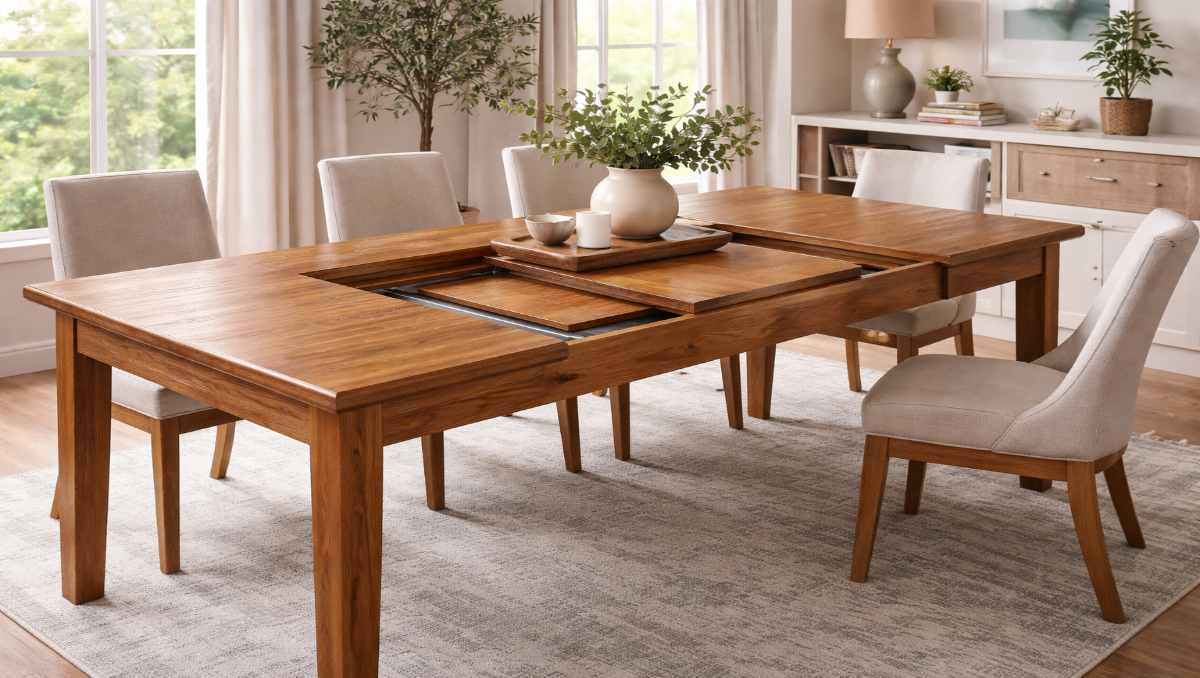
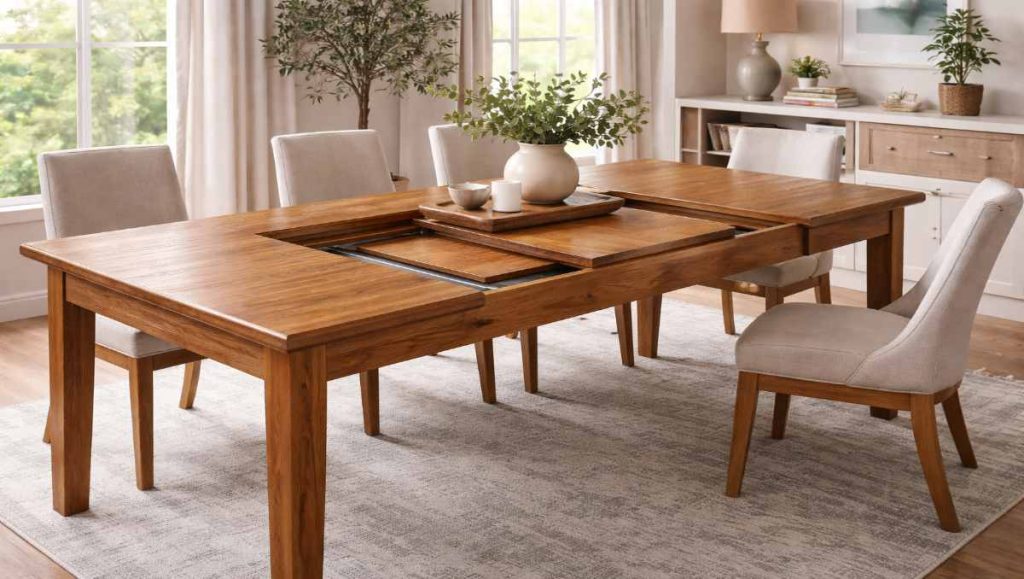
If you’ve ever hosted a holiday dinner, you know that awkward moment where you’re digging a dusty table leaf out from behind a stack of coats, hoping it hasn’t warped since last year. Traditional dining tables treat expansion as an afterthought, but a self-store dining table leaf changes the entire hosting dynamic by keeping the extra panels ready inside the table itself. For households that value efficiency, this built-in approach feels less like a modern upgrade and more like a simple, well-thought-out design.
Key Takeaways:
- A self-store dining table leaf works by storing the extension panel inside the table itself, allowing quick setup and tear-down while protecting the leaf from damage.
- An Amish dining table with self-storing leaves combines traditional craftsmanship with clever design, ensuring durability and smooth operation.
- Self-storing leaves eliminate the need for separate storage, speed up hosting preparation, and preserve a clean, visually appealing table top when not in use.
In this article, we’ll break down exactly how a self-storing dining table leaf works, the mechanisms behind it, and why it continues to be a favorite choice for families who want flexibility without clutter.
What Is a Self-Store Dining Table Leaf?
The dining table leaf has its roots in practical household design, dating back to the 17th and 18th centuries when homes needed flexible furniture to accommodate both daily life and occasional gatherings. Early table leaves were simple boards added to the sides or ends of tables and removed when not needed. As furniture making evolved, cabinetmakers began looking for ways to make these extensions easier to use and store, especially in homes where space was limited.
The self-store dining table leaf developed as a natural solution to those challenges. By building the extension directly into the table, furniture makers eliminated the need for separate storage and reduced the risk of damage or loss. Over time, advances in woodworking and hardware led to smoother glide systems and folding or pivoting mechanisms that could be operated by a single person. Today, self-storing leaves are valued for their convenience, durability, and ability to adapt a solid wood dining table to changing needs without sacrificing craftsmanship or space.
Why Amish Dining Table With Self-Storing Leaves Are Different
An Amish dining table with self-storing leaves stands apart because the mechanism is treated as part of the craftsmanship, not an add-on. Rather than relying heavily on mass-produced hardware, many Amish builders integrate the leaf system into the table’s structure using solid wood runners, precision joinery, and time-tested construction methods. This approach prioritizes long-term stability, ensuring the table opens smoothly and stays flat even after years of seasonal wood movement.
Another key difference is material integrity. Amish tables are typically made from solid wood types like oak, cherry, maple, or walnut, and the self store dining table leaf is crafted from the same boards to maintain grain consistency and color matching. This makes the extension feel like a natural continuation of the table rather than a visible insert. Combined with hand-finished surfaces, the result is a table that expands without looking or feeling compromised.
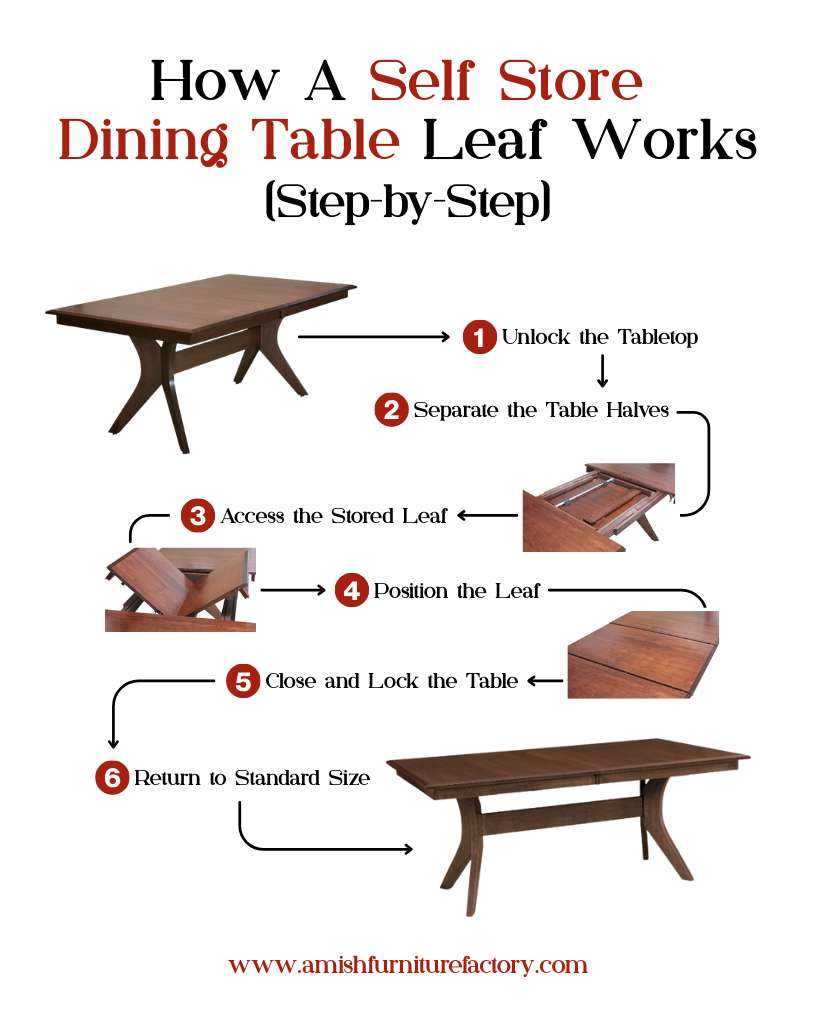
How A Self Store Dining Table Leaf Works (Step-by-Step)
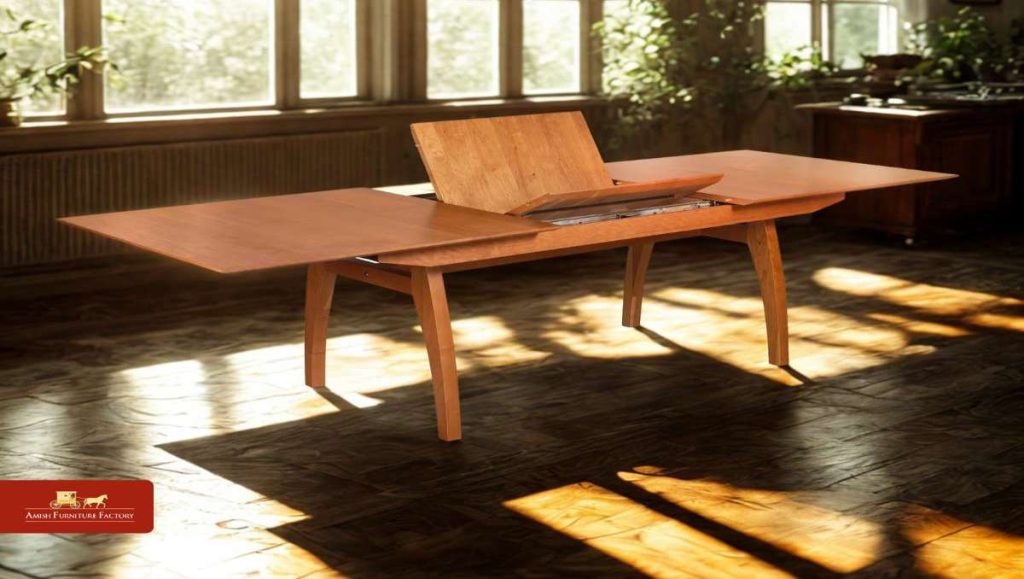
Here’s a step-by-step guide on how self-store dining table works:
Step 1: Unlocking the Tabletop
Most self-store dining tables begin with a subtle locking mechanism beneath the table top. Releasing the lock allows the two main halves of the table to separate smoothly along built-in tracks.
Step 2: Separating the Table Halves
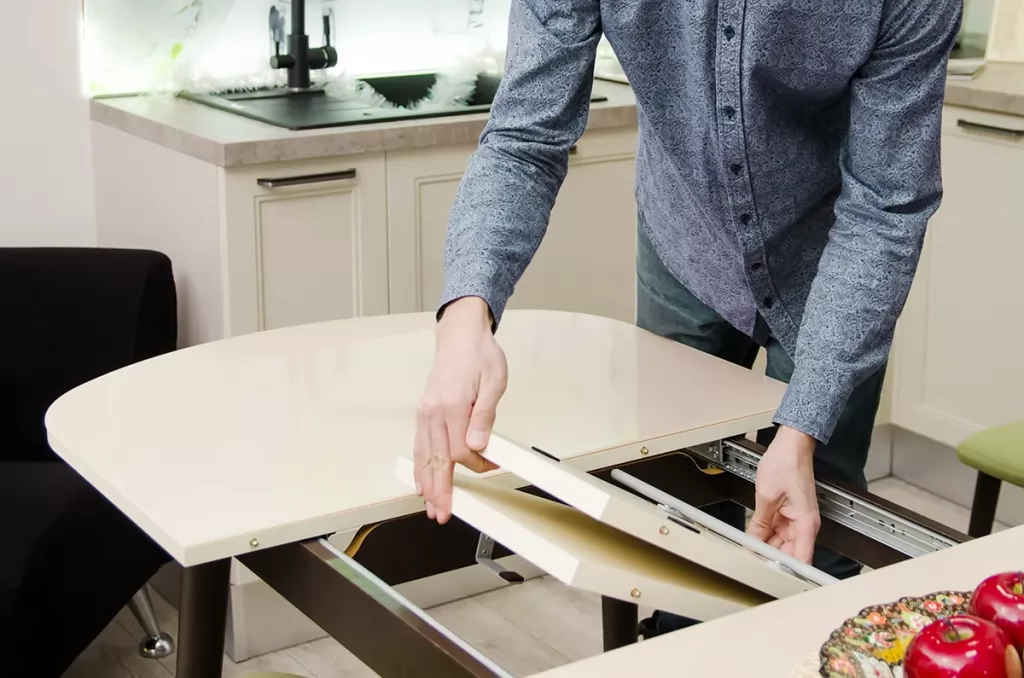
Once unlocked, the table top slides apart, usually guided by metal or solid wood runners. These tracks are engineered to keep both sides level and aligned.
Step 3: Accessing the Stored Leaf
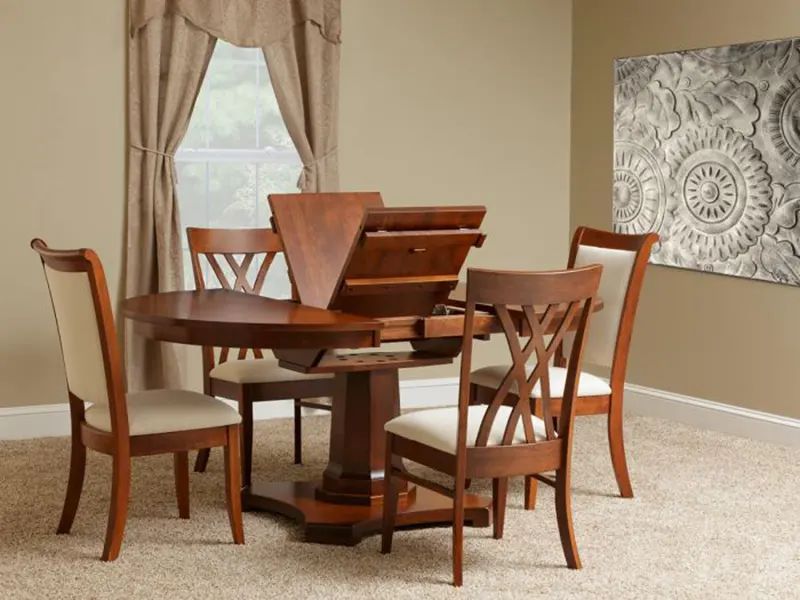
The leaf is housed inside the table’s apron or center cavity, protected from dust and impact. Depending on the design, it may fold in half, swing out on hinges, or rotate upward into position. This internal storage is what distinguishes a self store dining table leaf from removable alternatives.
Step 4: Positioning the Leaf
After unfolding or rotating the leaf, it is lifted or slid into the open center gap. Alignment pins, dowels, or tongue-and-groove edges help guide the leaf into the correct position.
Step 5: Closing and Locking the Table
With the leaf in place, the table halves are pushed back together until they meet the extension panel. The locking mechanism is then re-engaged, securing all sections into a single table surface. When properly closed, the leaf blends seamlessly with the rest of the tabletop.
Step 6: Returning to Standard Size
To reverse the process, the table is unlocked, separated, and the leaf is folded or rotated back into its storage compartment. The tabletop halves slide together again, restoring the table leaf to its original footprint.
Types of Self-Storing Dining Table Leaf Systems
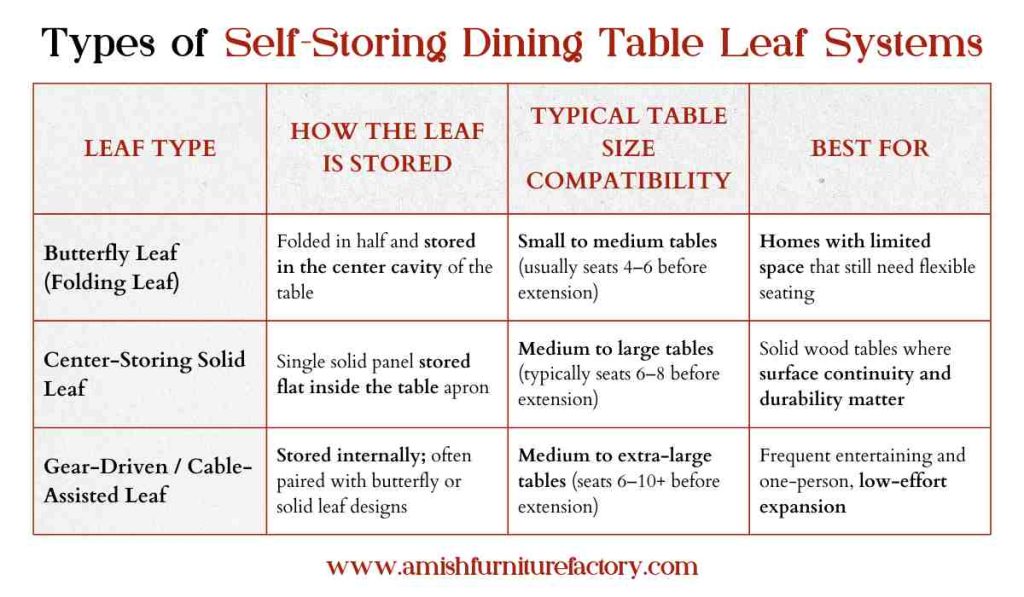
Not all self-storing dining table leaves work the same way. The differences come down to how the leaf is stored, how it moves, and how much mechanical assistance is involved during extension.
Butterfly Leaf (Folding Leaf)
A butterfly leaf, sometimes called a folding leaf, is designed to fold in half and store inside the center of the table. When the tabletop is pulled apart, the folded leaf is lifted, unfolded, and laid flat into the opening. This system is popular because it allows a full-size extension to fit within a relatively shallow storage cavity.
Center-Storing Solid Leaves
Center-storing solid leaves are single, full-width panels stored inside the table without folding. When the table opens, the leaf slides or lifts out and is positioned between the two tabletop halves. This system is often favored in solid wood furniture, including many handmade Amish dining tables, because it avoids hinges and preserves continuous wood grain patterns across the surface.
Gear-Driven or Cable-Assisted Systems
Gear-driven or cable-assisted systems use internal hardware to synchronize the movement of both table halves. When one side is pulled, the other side moves automatically, keeping the opening centered and evenly spaced. This makes extension smoother and reduces the need for manual alignment.
Advantages of Self-Storing Dining Table Leaves
Self-storing dining table leaves are designed to make expansion feel effortless rather than inconvenient.
No Separate Storage Required
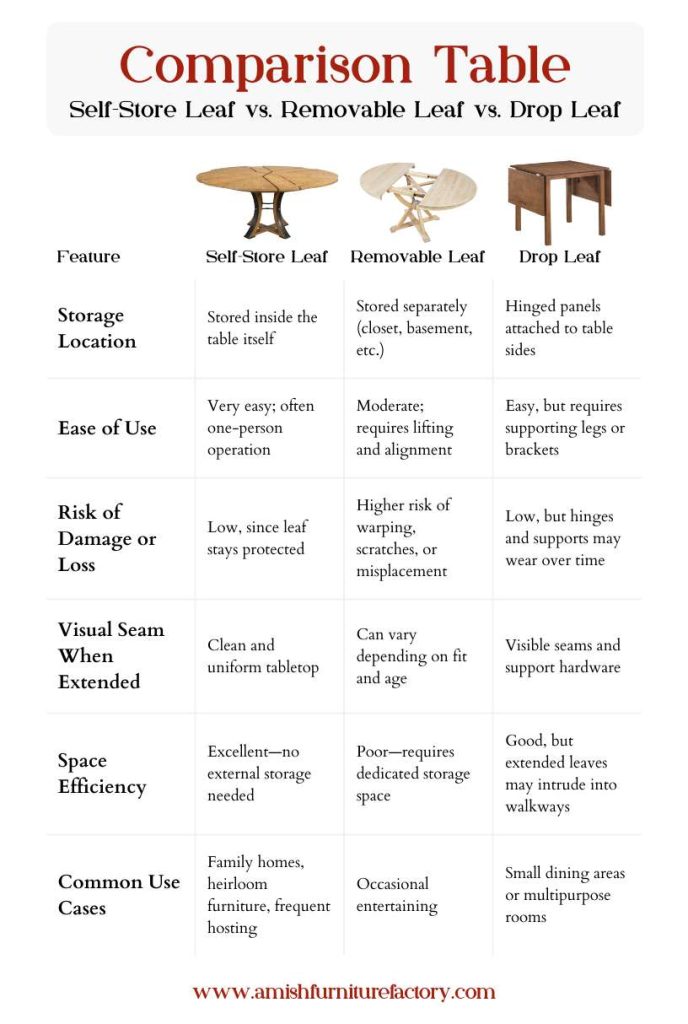
One of the most practical benefits of a self store dining table leaf is that it eliminates the need for external storage altogether. The leaf stays protected inside the table, removing the common problem of finding space in closets, basements, or garages.
Faster Setup for Guests
When guests arrive, time matters. Self-storing systems allow the table to expand in moments, often with a single person handling the entire process. There’s no lifting heavy panels, no searching for missing hardware, and no awkward alignment.
Reduced Risk of Lost or Damaged Leaves
Removable leaves are notorious for going missing or suffering damage between uses. A self-storing leaf remains part of the table, which virtually eliminates the risk of loss.
Cleaner Visual Design When Closed
When not in use, a self-storing leaf disappears completely, preserving the table’s original proportions and lines. There are no visible hinges, brackets, or mismatched seams drawing attention.
Potential Drawbacks and Limitations
While self-storing dining table leaves offer clear advantages, they aren’t without trade-offs.
Added Table Weight
A table designed to house its own leaf naturally requires more material and internal structure. This isn’t usually an issue once the table is in place, but it can matter during delivery, room rearrangements, or moves.
Slightly Thicker Table Profiles
To accommodate a self store dining table leaf, the table apron and underside often need additional depth. This can result in a slightly thicker or heavier-looking profile compared to minimalist tables without extension systems.
Higher Upfront Cost for Quality Builds
Self-storing mechanisms require precise construction and, in many cases, higher-grade materials. As a result, well-built tables with integrated leaves often cost more upfront than tables with removable extensions.
Maximize your seating capacity for any gathering by exploring our handcrafted Amish dining tables, designed to integrate these versatile leaves for a perfect fit.
Maintenance Tips for Self-Storing Dining Tables
Here are some essential tips to maintain both the table and its leaf system:
- Regularly clean the tracks and hinges to prevent dust and debris from interfering with smooth movement.
- Check locking mechanisms periodically to ensure they engage securely and maintain table stability.
- Condition the wood with appropriate oils or finishes to prevent drying, cracking, or warping.
- Avoid excessive weight on the extended leaf to prevent stress on the storage mechanism.
- Lubricate moving parts sparingly with a dry or silicone-based lubricant to keep dining table slides and gears operating quietly.
- Store the leaf in its designated compartment at all times when not in use to protect it from moisture and accidental damage.
- Inspect for loosened screws or hardware regularly, especially after moving or heavy use, and tighten as needed.
Final Thoughts on Self-Store Dining Tables
Self-storing dining tables represent a thoughtful blend of craftsmanship, practicality, and design. They simplify hosting, protect valuable leaves, and maintain a clean, seamless appearance when not in use. Whether you’re considering a modern table or investing in an Amish dining table with self-storing leaves, understanding how these systems work and their advantages can help you choose a table that fits both your space and lifestyle. Proper care and maintenance ensure that these tables provide decades of reliable use, making them more than just a convenience; they’re a long-term solution for adaptable dining.
Frequently Asked Questions
How many leaves can a self-storing table hold?
Most self-storing dining tables are designed to hold one or two leaves, depending on the table’s size and storage capacity. Some larger tables, especially custom or Amish-made designs, can accommodate multiple leaves to allow for significant expansion without compromising stability.
Do table leaves need to be stored flat?
Yes. This keeps the leaf protected from warping, scratches, or misalignment, ensuring a proper fit every time the table is extended.
How long do self-storing dining table mechanisms typically last?
With proper care and occasional maintenance like cleaning tracks and lightly lubricating moving parts, self-storing mechanisms can last for decades. Heirloom-quality hardwood tables, particularly those made by Amish craftsmen, often see reliable operation for 20–30 years or more.
Can an Amish dining table with self-storing leaves be customized for more seating?
Yes. Many Amish table makers offer custom options to add extra leaves or extend the overall table length. Customization options can also include wider panels or alternative leaf mechanisms to suit specific hosting needs.
Do self-storing leaves affect the table’s stability over time?
When properly constructed, self-storing leaves do not compromise stability. High-quality tables use precise joinery, locking mechanisms, and durable materials to ensure the extended table remains level and secure, even after years of use.