
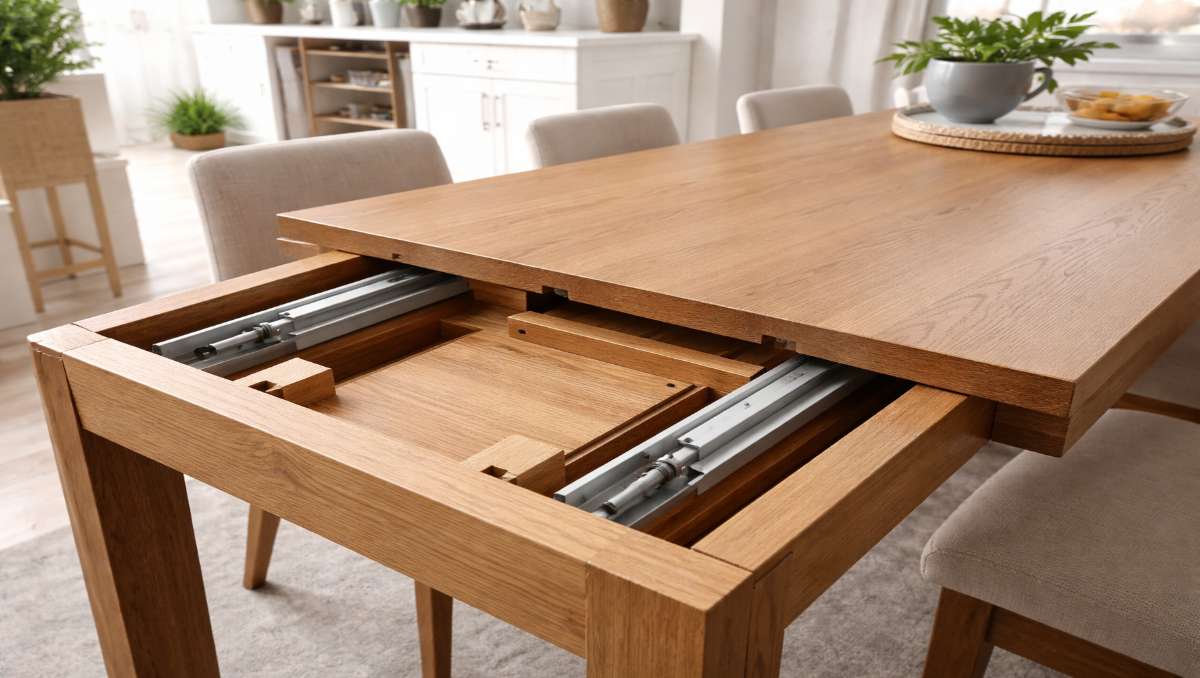
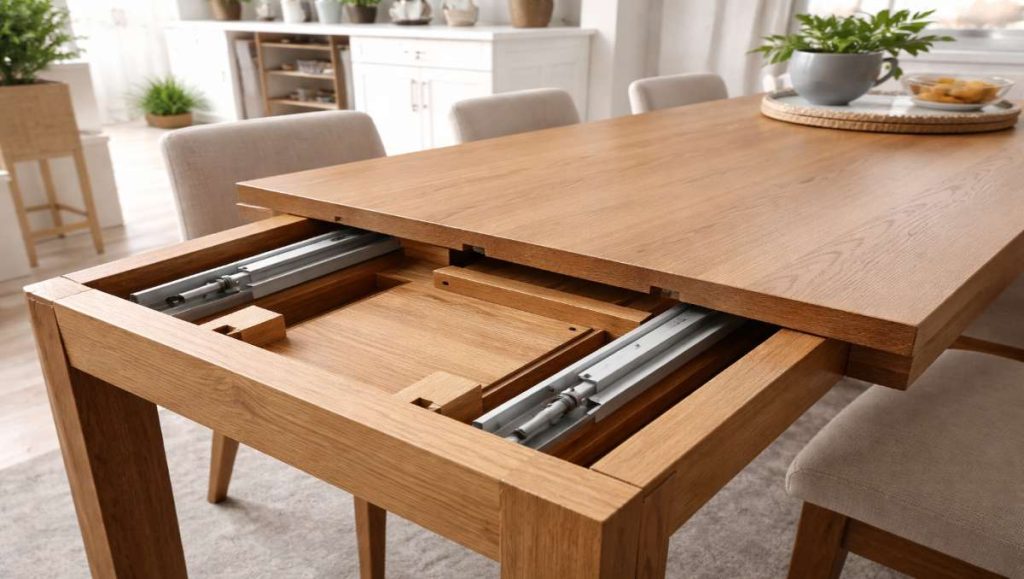
If you’ve ever seen how a dining table seems to effortlessly expand, you’ve already witnessed how the dining table extension mechanism works. These mechanisms are what make it possible to extend a table’s surface without compromising stability or style. While we often focus on the wood, design, or finish, it’s the dining table extension mechanism that determines how smoothly your table opens. The kind of mechanism your table uses will affect durability, ease of use, and even the overall lifespan of the furniture.
Key Takeaways:
- Dining table slides are the hidden hardware that makes extending a table smooth and stable. The dining table extension mechanism refers to the entire system, including slides, leaves, and locks.
- Common mechanisms include center-leaf, end-leaf/draw-leaf, butterfly leaf, and drop-leaf, each suited for different spaces and lifestyles.
- When choosing a mechanism, consider space, ease of use, durability, style, and hosting needs.
Whether you’re shopping for a new dining table or restoring a family heirloom, knowing the various options can help you choose one that fits both your lifestyle and the way you host gatherings.
What is a Dining Table Slide?
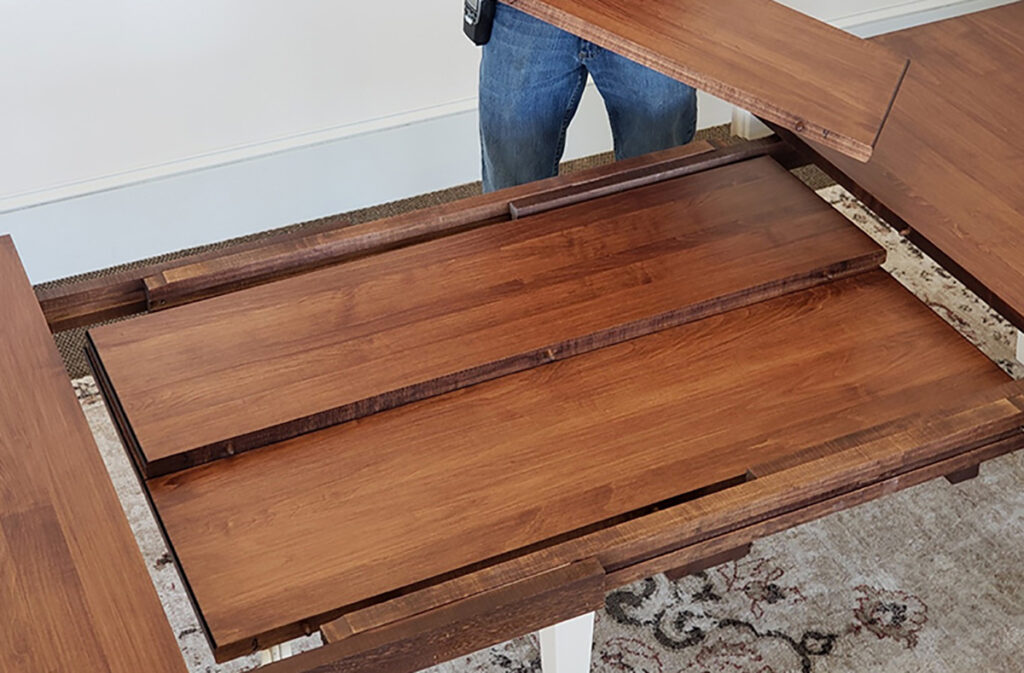
A dining table slide is the hidden hardware system that allows a table to expand and contract. Think of it as the guiding rails beneath the tabletop that let you pull the two halves apart and insert leaves or extensions. Well-engineered slides ensure smooth movement, carry weight evenly, and prevent wobbling during use.
Alex Smith, Home Interior Architect of Render3DQuick.com, explains:
“To provide flexibility in seating, dining table slides are present. They are designed to allow a small table to be used by more people without becoming unstable.”
Over time, manufacturers have developed several types of dining table slides, each with unique advantages in strength, ease of use, and longevity.
Slide vs Dining Table Extension Mechanism
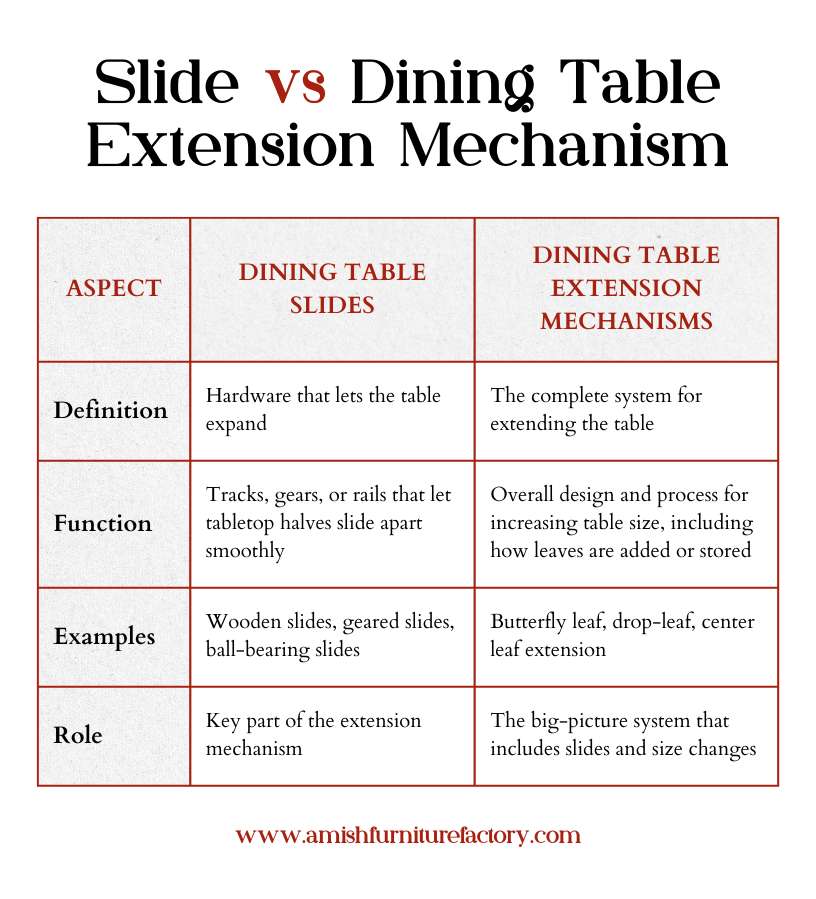
While the terms are often used interchangeably, there’s a subtle distinction between a dining table slide and a dining table extension mechanism. Dining table slides refer specifically to the guiding rails or tracks that allow the two halves of the table to separate smoothly. They’re the backbone of the system.
Dining table extension mechanism, on the other hand, is the broader term. It includes not only the slides but also the design of the leaves, how they’re stored (self-storing or separate), and the locking systems that hold everything in place. In other words, slides are one part of the mechanism, but the full extension system involves more moving pieces.
The Main Types of Dining Table Slide Types
Choosing the right dining table slide comes down to preference and table design. Each type has strengths and trade-offs depending on durability, smoothness, and compatibility with different dining table bases.
Wooden Slides
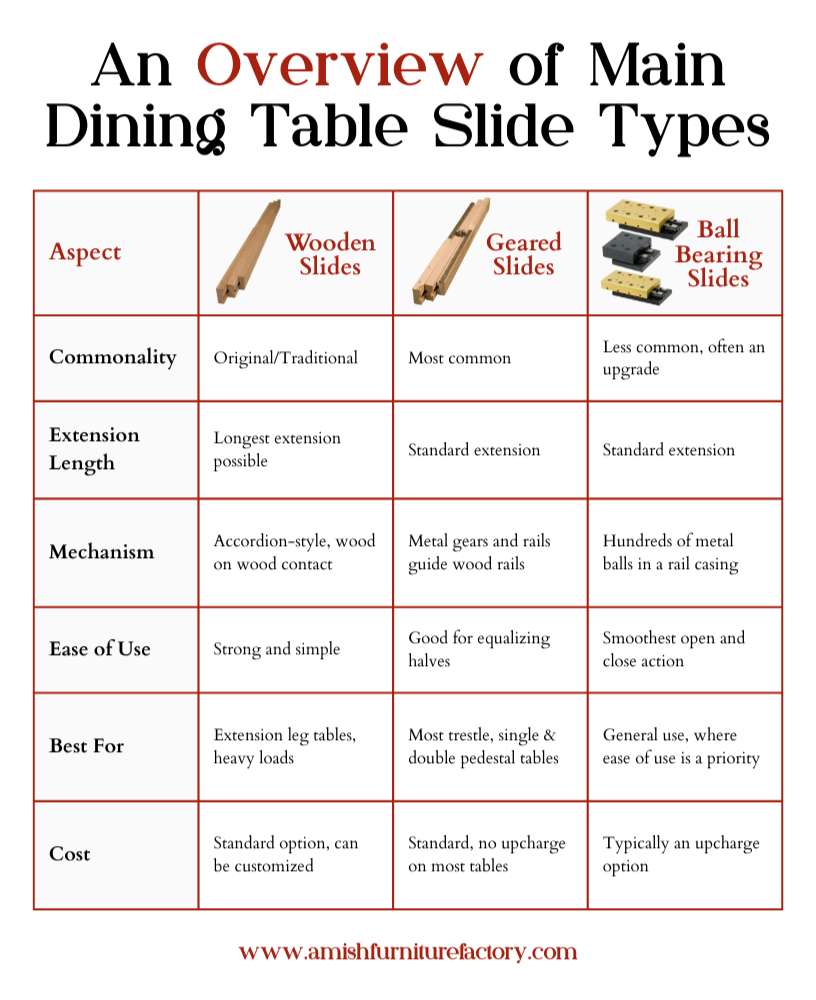
Wooden slides are the original and most durable type of table extension mechanism. Built from staggered wood rails that extend in an accordion-like fashion, they allow tables to expand the farthest—making them ideal for leg tables with multiple 12-inch leaves that can stretch over twelve feet. Their solid wood construction gives them exceptional strength and stability, allowing them to support heavy loads while maintaining a classic, traditional aesthetic that complements timeless furniture designs.
However, wooden slides can be bulkier and less smooth to operate compared to modern alternatives. Extending the table often requires two people, as the mechanism may need to be carefully guided and aligned. Despite these drawbacks, wooden slides remain a reliable choice for those prioritizing strength, craftsmanship, and authenticity.
Geared Slides
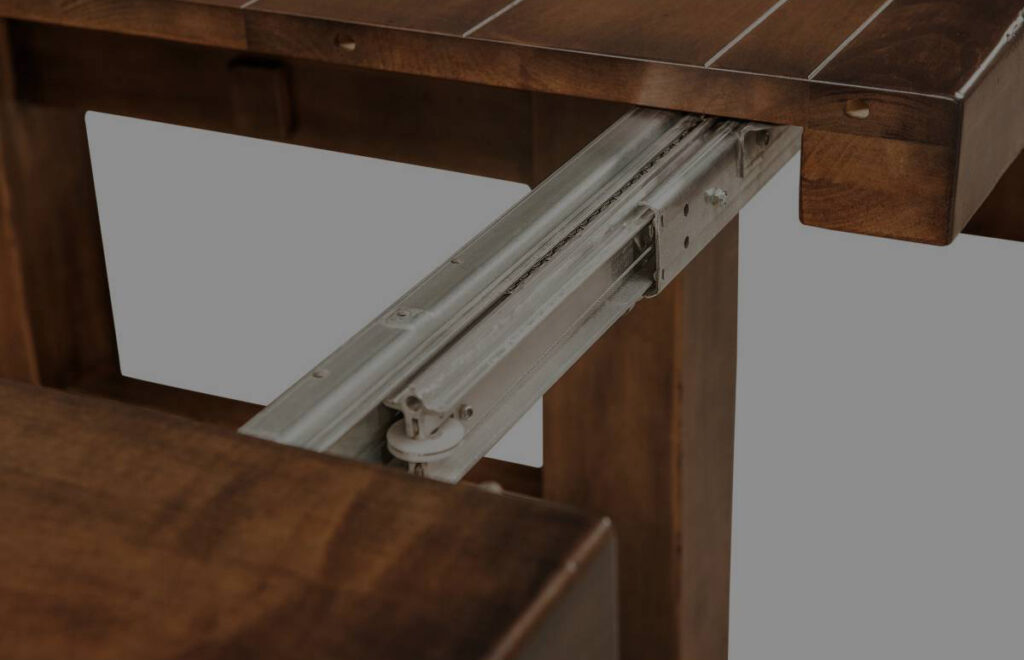
Geared slides are the most common type of table extension mechanism, featuring metal gears that ensure both sides of the table move evenly and smoothly. This design provides a balanced, controlled extension that works especially well with pedestal or trestle bases. As Alex explains:
“Gear slides have a central mechanism in which gears maintain both ends moving in perfect time.”
Their clean, mechanical look suits modern and transitional designs, and they often support convenient features like self-storing leaves. On the downside, geared slides have a more limited extension range compared to wooden slides and tend to be heavier due to their multiple moving parts. While they are easier to operate overall, extending the table may still require two people for smooth alignment and stability.
Ball Bearing Slides
Ball bearing slides offer the smoothest and most effortless operation of all table extension mechanisms. Inside each rail casing, hundreds of tiny metal balls reduce friction, allowing the table to open and close seamlessly—often with just one hand. Alex notes:
“Ball-bearing slides are easier to move, and their advantages are seen in the heavier tables with wide leaves. They are found on wooden slides, and on olden-day tables, but only when in good condition.”
This design provides a refined, mechanical feel that enhances the usability and precision of modern extending tables. However, ball bearing slides are generally not as strong as geared or wooden slides, making them less ideal for extremely large or heavy tabletops. Their lightweight construction and numerous moving parts can also limit durability and make self-storing leaves less feasible.
You might be interested to explore the different shapes of dining table for open-concept spaces.
How to Choose the Right Dining Table Slide
Selecting the right dining table extension mechanism is about how well the table fits your space, lifestyle, and how often you’ll actually use the extension. Here are some important factors to keep in mind:
- Space Availability: Drop-leaf tables work best for compact dining areas or apartments. Center-leaf or butterfly systems are better suited for larger rooms.
- Ease of Use: Butterfly and end-leaf designs are the most convenient since the leaves are self-storing. Center-leaf tables require storing the leaves separately.
- Durability & Stability: Heavy-duty slides (metal or ball-bearing) provide stronger support for frequent use. Wooden slides may require more maintenance over time.
- Style & Aesthetic: Drop-leaf tables lean toward casual or cottage-style dining. Center-leaf and butterfly tables offer a more formal and balanced appearance.
- Family & Hosting Needs: If you host large gatherings, a center-leaf table with multiple leaves offers the most seating flexibility. For smaller households, a simple drop-leaf or butterfly system might be more than enough.
Alex concludes: “Equalization of slides, which has been common in recent designs, allows the same individual to extend both ends at the same time, saving labor and preventing uneven loading on the frame.”
Discover the smooth functionality of different dining table slides, then find the perfect one for your home with a handcrafted Amish dining table built for generations of family gatherings.
When to Replace or Upgrade Your Dining Table Slides
You’ll want to replace or upgrade your dining table slides when everyday use becomes inconvenient or the table no longer performs as intended. Common situations include when the table is difficult to expand during family meals, when guests are coming over and the leaves don’t align properly, or when the mechanism feels unstable once extended. These issues often appear in older tables, especially those with wooden slides that have warped over time or metal tracks that have rusted.
Upgrading also makes sense when your lifestyle changes. For example, if you’re hosting larger gatherings more often, modern slides allow for smoother expansion and better weight support. Likewise, if your dining room is being remodeled, upgrading the slides while refinishing the table ensures everything looks and works like new.

Switching to modern slides improves your table’s functionality and lifespan. Newer designs glide more smoothly, hold weight more securely, and often support larger extensions, giving you extra seating capacity. They also require less maintenance, making your dining table easier and more enjoyable to use for years to come.
Conclusion
Dining tables are more than just furniture; they’re gathering spaces. And at the heart of their flexibility are the dining table slides and the broader dining table extension mechanisms that make expanding the table possible. From traditional center-leaf designs to space-saving drop-leaf tables, each mechanism offers its own strengths depending on your lifestyle, room size, and hosting needs. Understanding these details helps you choose a table that’s not only beautiful but also built for everyday functionality.
Frequently Asked Questions
What is an equalizing dining table slide?
An equalizing slide is a mechanism that allows one person to open both sides of the table at once. When you pull one end, the opposite side moves simultaneously, making it easier to expand the table smoothly without tugging on both ends.
Can I replace my old dining table slides with a different type?
In many cases, yes. For example, older wooden slides can sometimes be upgraded to modern metal or ball-bearing systems for smoother motion. However, compatibility depends on the table’s design and construction, so measuring carefully (or consulting a furniture repair professional) is recommended.
How can I fix a dining table extension mechanism that is stuck or binding?
Start by checking for dirt, debris, or wood swelling that might be causing friction. Lubricating the slides with furniture-safe wax or silicone spray often helps. If the mechanism is warped or damaged, replacement parts may be necessary.
Do all extendable dining tables come with built-in leaf storage?
No. Some tables, like butterfly or draw-leaf models, have self-storing leaves. Others, particularly center-leaf designs, require you to store leaves separately, which may be less convenient but allows for larger expansion.
How much weight can dining table slides safely support, and what specs should I check?
Weight capacity varies by slide type. Heavy-duty metal slides can often support 100–200 lbs or more, while older wooden slides may hold less. Always check the manufacturer’s specifications for load limits, especially if you plan to place heavy centerpieces or multiple dishes on the extended table.
I am interested in ordering a table. I have one but it is too small wanting a larger one and chairs.
I have an antiques 5 leg oak table that has an extension slide that has worn out that enables me to get a 120″ opening enabling me to insert 5 two foot extension board. I would like to replace it. Do you manufacture a slide that can meet my needs
Two extension gear type slides broke. Will you sell me a pair of the wooden slides?
How does the use of ball bearing slides in a table top design contribute to ease of operation and prevent binding between the two table top halves, and what makes the sound of rolling metal balls inside the slide rail casing appealing in this context?
I have lost the gear for my dinning room table. If you have any gears could I email you some picture of the table with the gear measurements?