


Among the Amish, few ideas shape daily life as quietly yet powerfully as Hochmut (pride) and Demut (humility). These aren’t just religious practices tucked into sermons; they’re working principles that help families decide how to dress, how to work, how to treat one another, and even how to approach modern technology. Understanding Hochmut and Demut offers a rare window into why the Amish live the way they do.
Key Takeaways:
- The Amish use the German language Hochmut (pride) and Demut (humility) to guide decisions, ensuring that personal ambition never overshadows community well-being.
- Humility is embedded in work, dress, education, and community participation.
- The Ordnung formalizes these values, providing clear behavioral expectations that reinforce mutual accountability and spiritual discipline.
In this article, we’ll explore what these values mean, how they influence daily life, and why they remain central to Amish identity even in a rapidly changing world.
Understanding Demut: The Amish Concept of Humility

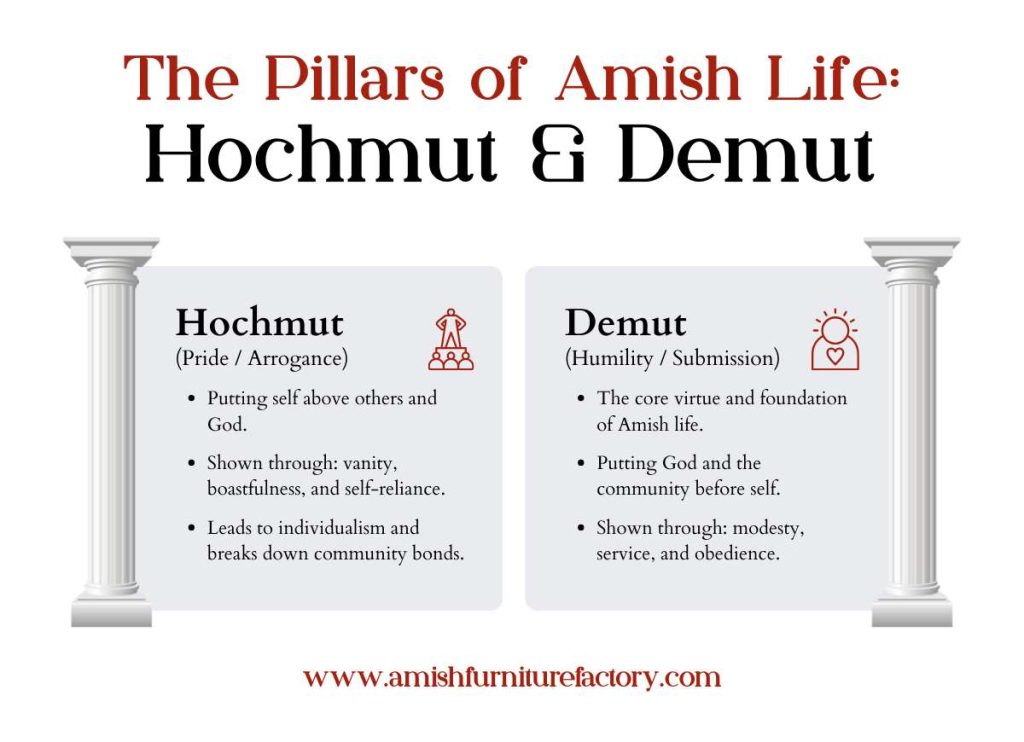
At the heart of Amish identity lies “Demut” — humility, modesty, and self-submission. Humility for the Amish isn’t merely a private virtue; it shapes their relationships, their decisions, and their sense of belonging. Through Demut, individuals learn to prioritize community cohesion over personal ambition, aligning their lives with faith, simplicity, and mutual respect. Demut is also embedded in their spiritual framework. In living with Demut, Amish communities foster unity, shared responsibility, and a deep sense of belonging rooted not in individual glory but in collective faithfulness.
Learning Hochmut: The Amish Concept of Pride
For the Amish, “Hochmut” or pride, arrogance, or self-exaltation, is not just a personal failing, but a spiritual danger. Amish tradition warns that Hochmut undermines communal harmony and spiritual humility; it represents the kind of self-assertion and vanity that conflicts with the collective values of faith and fellowship. As a result, many common Amish practices are designed to guard against it. Plain clothing, the avoidance of jewelry or flashy adornments, refusal of personal photographs or public displays of success. These are not arbitrary old-fashioned habits, but deliberate measures.
The Role of Ordnung in Formalizing Humility and Restricting Pride
For the Amish, the Ordnung is the living, guiding framework that turns the ideals of humility and community into everyday life. This code, though largely unwritten, covers nearly every facet of life: dress, technology, transportation, schooling, and social behavior.More than mere restrictions for their own sake, these guidelines encourage what the Amish call Gelassenheit (submission, calmness, modesty), and push members to subordinate personal ambition or vanity for the good of the community.
Because each Amish church district maintains its own Ordnung, the community collectively agrees to abide by the code. This shared acceptance transforms the Ordnung from an abstract moral ideal into a communal covenant: members choose to live under mutual accountability, giving up the pursuit of individual status or outward appearance in favor of spiritual discipline and group harmony.
Amish Lifestyle Through the Lens of Hochmut and Demut
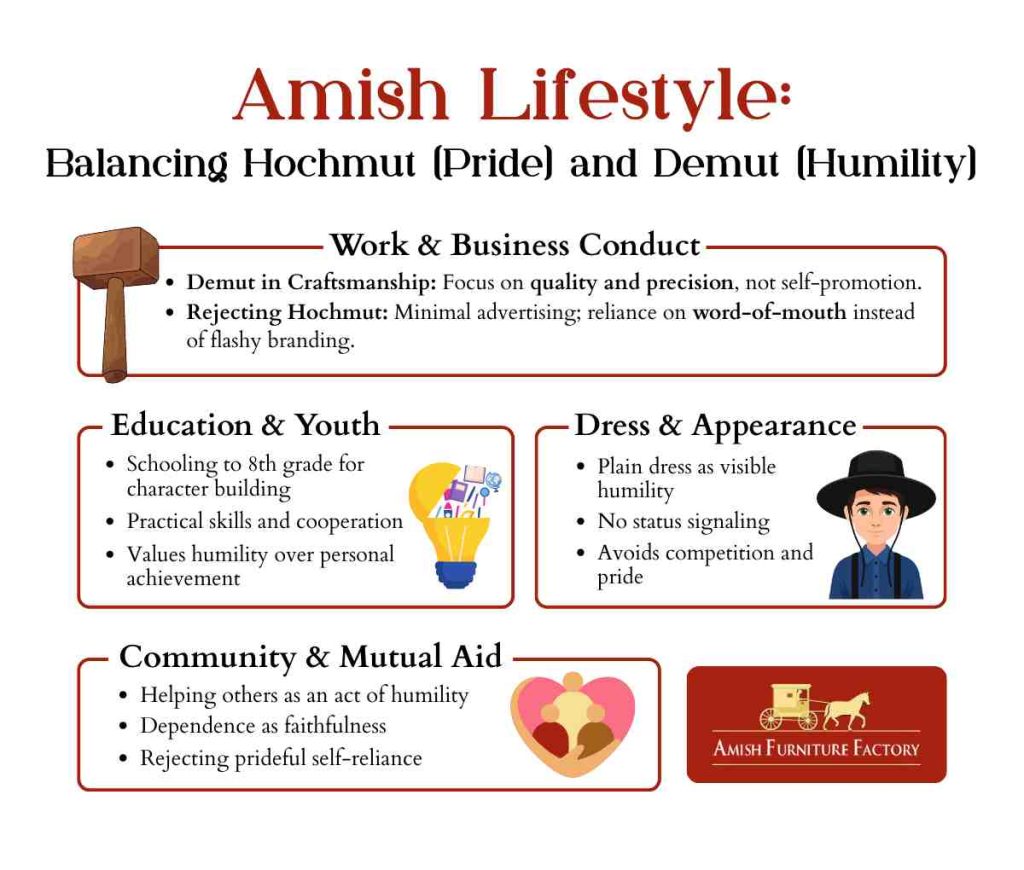
The daily rhythms of Amish life is easier to understand when viewed through the balancing act between avoiding Hochmut (pride) and nurturing Demut (humility).

Working With Purpose: Craftsmanship and Business Conduct
Amish work culture is intentionally shaped by humility. Their craftsmanship, known for its quality and precision, is carried out without self-promotion or flashy branding. Many Amish businesses avoid advertising entirely and rely instead on word-of-mouth, reinforcing the belief that skill should speak for itself rather than elevating the individual.
Discover the craftsmanship that defines the Amish lifestyle—browse our collection of authentic Amish furniture and bring a piece of this tradition into your home.
Forming the Next Generation: Education and Youth Development
Amish education, typically ending at the eighth grade, is designed to build character and community values, not personal advancement. Youth learn practical skills, cooperation, and religious commitment, which collectively help them resist Hochmut and embrace Demut. Even during Rumspringa, the community gently encourages discernment over self-indulgence.
Choosing Modesty: Dress and Personal Appearance

Amish clothing is one of the most visible expressions of their commitment to humility. Plain, uniform dress removes pressure to stand out or signal social status, making pride far less likely to take root. By wearing simple, durable garments free of decoration, the Amish transform everyday appearance into a quiet practice of spiritual discipline.
Strengthening Bonds: Community Events and Mutual Aid
Barn raisings, auctions, funerals, weddings, and countless acts of shared labor all reinforce Demut by reminding members that no one stands alone. Mutual aid discourages self-reliance taken to the point of pride. Instead, it cultivates an Amish culture where asking for help, giving help, and depending on one another are signs of faithfulness rather than weakness.
Comparing Amish Humility With Other Christian Traditions
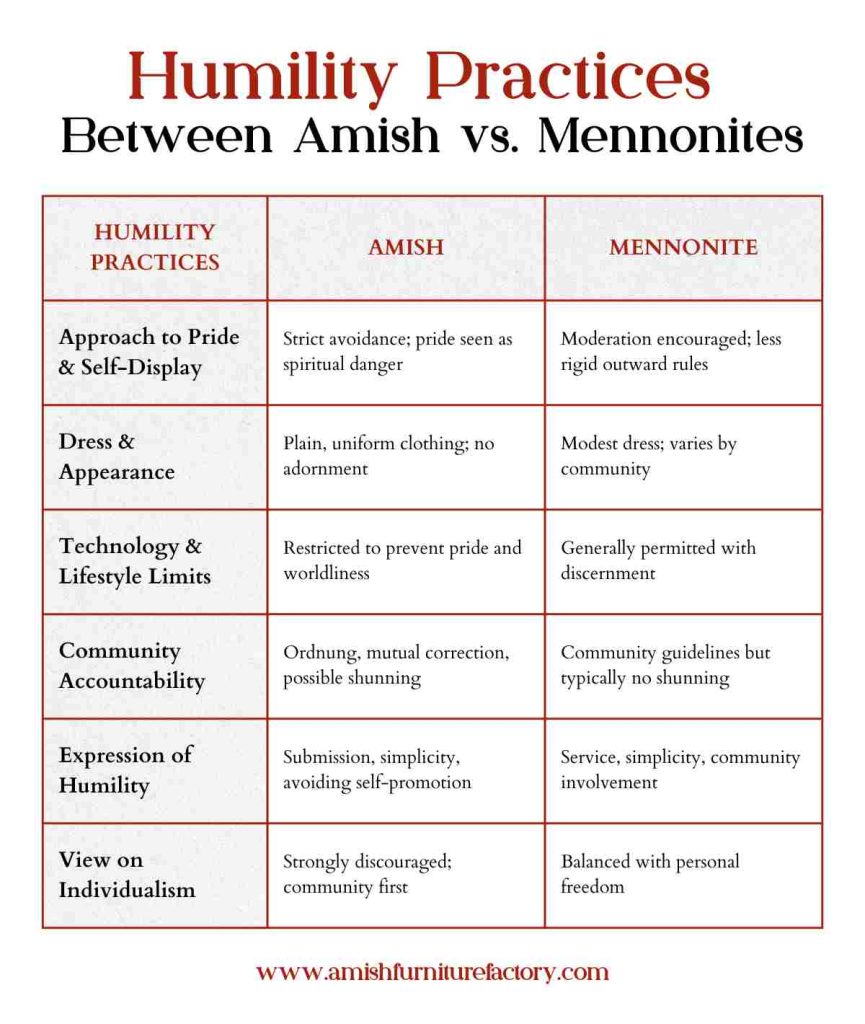
While humility is a shared Christian virtue, the Amish express it in especially structured and visible ways. Many Christian traditions teach modesty, submission to God, and avoidance of vanity, but the Amish make these principles central to everyday life. Old Order Mennonites share many of these roots but typically apply them with more flexibility. Looking at these side by side highlights how Amish vs. Old Order Mennonites interpret the same virtue through distinct cultural and theological lenses.
Modern Challenges and Critiques in Demut Practices
Even as the Amish strive to live with humility, modern pressures pose real challenges to maintaining Demut in daily life. Economic demands, land scarcity, and rising costs push many families toward small businesses, construction, or woodworking shops, requiring interactions with outsiders and exposure to markets that can tempt pride or self-interest.
Critics also point out that Demut practices may face tension with individual aspirations, especially among youth during Rumspringa or those exposed to modern culture. While humility is highly valued, the strict lifestyle rules can create friction between personal growth and communal expectation. Scholars note that maintaining true humility today involves a delicate balance: integrating necessary adaptations without allowing pride, status-seeking, or material ambition to erode the foundational values of Amish life.
When Pride Emerges: Conflict, Correction, and Restoration

Even in a community built on humility and mutual respect, there are times when a person may drift toward pride or break the shared covenant of Ordnung, perhaps by adopting forbidden technology, rejecting communal norms, or behaving in a way seen as arrogant or divisive. In such cases, the community doesn’t ignore the problem. Instead, elders or church leaders often attempt to intervene first through private admonition: reminding the person of their baptismal vows, urging repentance, and encouraging restoration of humility.
If the individual remains unrepentant, a more formal process may follow: public warning, probation, and if needed, excommunication and shunning.This separation is not meant as permanent vindictiveness, but as a pathway to correction and restoration. This is a way to encourage the person to return with renewed commitment to humility and communal values.
Living the Amish Way: Lessons from Hochmut and Demut
The Amish approach to life demonstrates how deeply values can shape both individual behavior and communal cohesion. By consciously balancing Hochmut (pride) and Demut (humility), the Amish maintain a lifestyle that emphasizes simplicity, mutual accountability, and spiritual discipline. Every choice, from work and dress to education and community life, is an opportunity to practice these principles. This preserves harmony while navigating both tradition and modern challenges.
Frequently Asked Questions
Can economic success create tension with Amish humility values?
Yes. While the Amish encourage industriousness and skillful work, accumulating wealth or status can create subtle tension with Demut. Families and communities often carefully manage how economic achievements are displayed, ensuring success does not foster pride or division.
How do the Amish distinguish between Hochmut (sinful pride) and a healthy sense of self-worth or competence?
Amish culture recognizes skill and competence as valuable, but they must be paired with humility and service to the community. Pride becomes problematic when it centers on self-glorification or undermines collective harmony.
Does the degree of Hochmut and Demut enforcement vary significantly between Old Order and New Order Amish communities?
Yes. Old Order Amish typically adhere to stricter interpretations of the Ordnung and more visible expressions of Demut. New Order Amish may allow slightly more flexibility in dress, technology, and business practices.
What role does Demut play in the Amish approach to healthcare and interaction with non-Amish, or “English,” society?
Demut encourages humility in healthcare choices, promoting careful deliberation and reliance on both community wisdom and faith. In interactions with outsiders, humility helps the Amish maintain respect, avoid conflict, and navigate external pressures without compromising their core values.
Considering naming my son, middle name, as Demut – As, I have read this is a Feminine noun, do you think this is appropriate?
Thanks for your input
Considering naming my son, middle name, as Demut – As, I have read this is a Feminine noun, do you think this is appropriate?
Thanks for your input
Demut would be an admirable name.
In a world of equality; names that don’t denote male/female are quite appropriate in 2018.