
When we think about the Amish, we often picture their plain clothing, horse-drawn buggies, and close-knit communities. Behind those outward traditions are deep spiritual beliefs that guide how the Amish navigate every part of life, including modern medical care. One question that often comes up is whether the Amish accept blood transfusions. It is a topic that touches on faith, family, and the balance between trusting God and using the tools of modern medicine.
Key Takeaways:
- Most Amish people accept blood transfusions as there’s nothing in their beliefs and understanding of the Bible that tells otherwise.
- They are likely to give their consent if they know that it’s for the benefit of the recipient.
- Unlike Jehovah’s Witnesses who refuse blood transfusions, the Amish accept blood transfusion, donate organs, and use modern medicine when needed.
In this article, we will explore the Amish perspective on blood transfusions, why some choose to refuse them, and how these decisions reflect the community’s broader values and beliefs.
The Amish Beliefs in Blood Transfusions

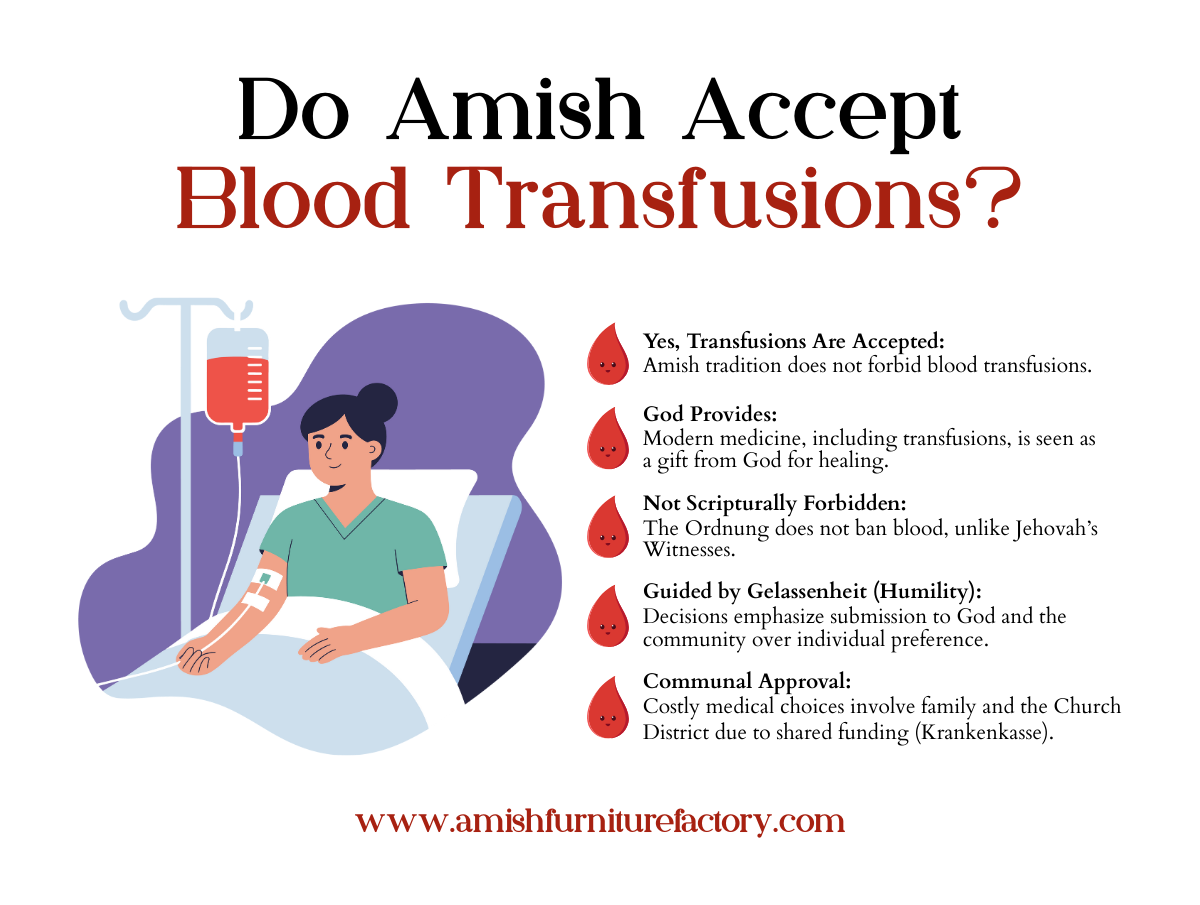
The Amish faith broadly does not prohibit modern medical treatments, including blood transfusions. According to scholars of Amish life, nothing in the Amish understanding of the Bible forbids “surgery, hospitalization, dental work, anesthesia, blood transfusions or immunization.” Rather than a strict religious ban, acceptance of medical care tends instead to be a matter of personal or family decision, often depending on the severity of the illness and on economic or community support considerations.
At the same time, the Amish worldview frames health as a gift from God. It’s something to be cared for responsibly, but also accepts that suffering or illness might be part of God’s will. Because many Amish do not carry formal medical insurance, when they do seek medical care, they often decide with consultation from church or community. Care for the cost may rely on mutual aid among their community.
Blood Donation Among the Amish
The same belief that makes receiving blood acceptable also supports the idea of donating it. Blood donation aligns naturally with Amish values of humility, service, and helping one’s neighbor. Many Amish view donating blood as an extension of Christian charity. For them, it’s a tangible way to give life to others without violating religious principles.
Amish donors often see it as a gift meant to be shared when it can save lives. When donation opportunities are accessible and clearly beneficial, Amish individuals are generally willing participants.
Amish Approach to Organ and Tissue Transplants
For the Amish, decisions about organ or tissue donation are left to the individual or family. While their faith does not prohibit organ donation, cultural and communal values heavily influence choices. Scholars note that the Amish “will consent to transplantation if they know it is for the health and welfare of the organ transplant recipient,” but actual donation is extremely rare due to respect for the body after death and traditional burial practices.
At the same time, Amish individuals may receive organ transplants if medically necessary. Their openness to modern medical procedures, means transplantation is viewed as permissible when it offers a real chance at survival. Decisions are often made with careful consideration of personal conscience, communal guidance, and faith in God. The process reflects the balance the Amish maintain between modern healthcare and traditional values.
Why Amish Organ Donation Is Rare in Practice

The Amish people fully support organ and tissue donation. However, due to the delay and disruptions in the Amish end of life traditions caused by the program, the Amish rarely agree to donate. According to a funeral director serving the Amish in Lancaster County for almost seven decades, he has seen precisely two who proceeded to donate organs out of approximately 1,500 approved organ donors reviewed by the organization. He has also experienced his fair share of emotional Amish families venting out due to the delays.
Live Amish donors will not hesitate to give for kidney or be a part of liver donations if they know that it is the only way to help the transplant recipient. If the outcome is uncertain, it’s not uncommon for them to feel reluctant or even oppose donation.
The Critical Distinction: Amish vs. Jehovah’s Witnesses
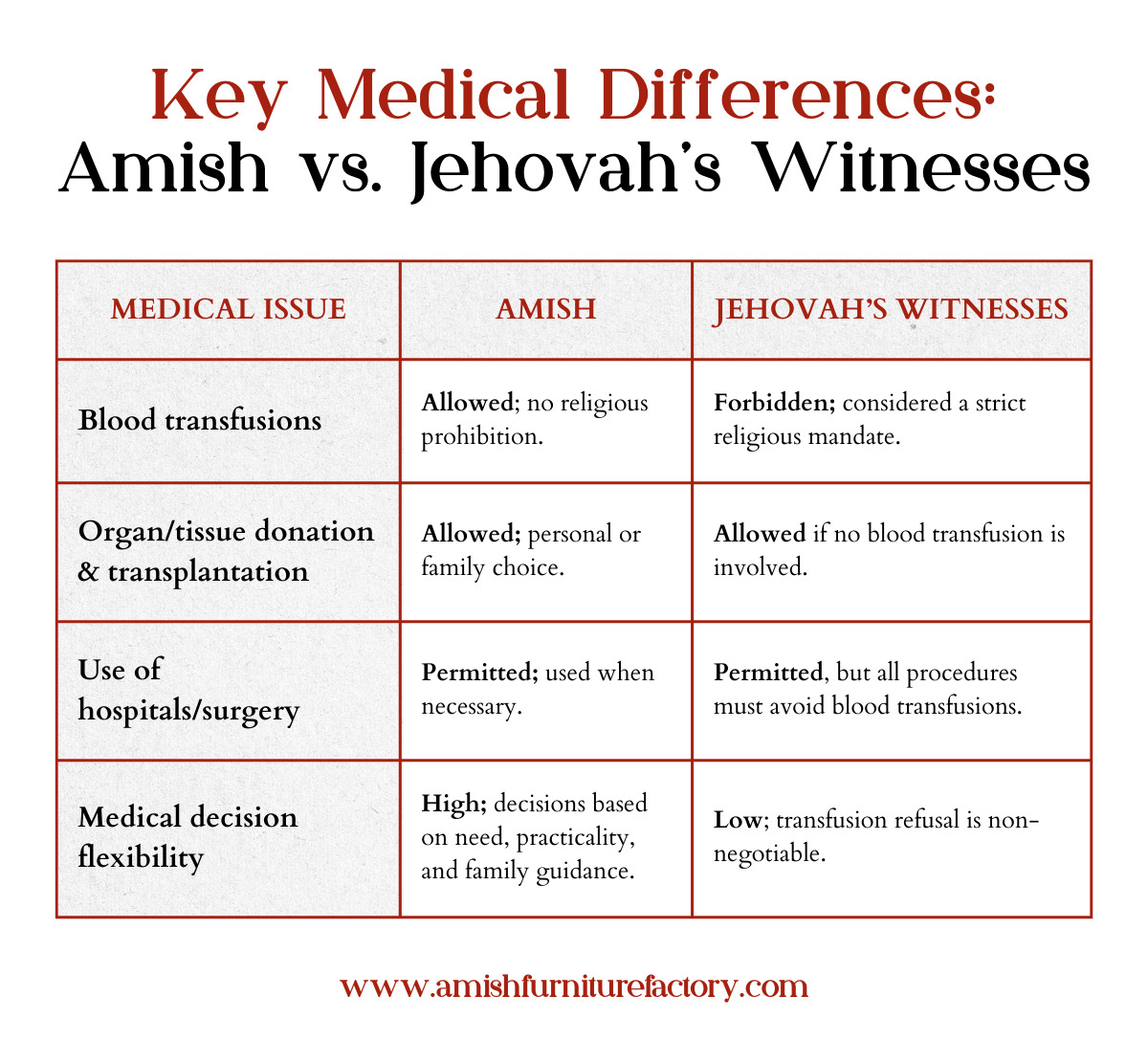
In the case of the Amish, there is no religious prohibition against blood transfusions. The same goes for organ transplantation or other modern medical interventions. In practice, many Amish individuals will use conventional medical care especially in serious or life‑threatening situations.
By contrast, Jehovah’s Witnesses hold a firmly grounded religious conviction against accepting blood transfusions. It’s based on their interpretation of Bible passages such as those in the books of Genesis, Leviticus, and Acts. For Witnesses, refusal of whole‑blood transfusion is considered mandatory, even when their life is at risk. Although they often willingly seek other forms of medical care, the transfusion ban remains a defining and non‑negotiable religious doctrine.
The Modern Perspective: Amish Interaction with Hospitals and Doctors
The Amish generally do not reject modern medical care; many will turn to doctors, dentists, specialists, and hospitals when the situation calls for it. Rather than rushing to a physician for every minor ache or discomfort, many Amish families initially rely on traditional home remedies, folk medicine, or less‑invasive options. In more serious situations, they are known to seek professional medical help and are typically accepted by hospitals and healthcare providers.
Because the Amish generally avoid conventional health insurance, they pay for medical expenses out‑of‑pocket or rely on community‑based support systems when large bills arise. Many hospitals and clinics familiar with Amish patients have developed accommodations to respect their cultural preferences, and some even have doctors who regularly treat Amish patients and understand their values.
Discover how the Amish ways shape decisions about modern healthcare services and community values. Learn more about their unique approach to medical ethics today.
The Bottom Line
Like the rest of us, the Amish value how important these life-saving treatments and modern medical services, such as blood transfusions and organ donations, are. Their generosity can extend up to this level. However, unlike the people outside their grid, they live by simplicity and centuries-old traditions derived from the bible that already define who they are.
The Amish life’s cornerstone is faith. They treat daily life as a spiritual activity. Therefore, nothing in this world could change how they usually do things inside their communities. If it comes to choosing between something written more precisely in the bible and something that is not, the first one will always be their choice.
Frequently Asked Questions
What blood types do the Amish have?
The Amish population primarily consists of descendants from a small group of Swiss and German founders, which has resulted in a relatively limited genetic pool. As a result, certain blood types, particularly O and A, are more common among Amish individuals, and some rare blood disorders are seen more frequently than in the general population.
Are there medical alternatives to blood transfusions that the Amish commonly use?
Yes. When a blood transfusion is needed, many Amish prefer alternatives such as iron supplementation, erythropoietin therapy (to stimulate red blood cell production), volume expanders, or bloodless surgical techniques. These options allow critical care while respecting personal or communal beliefs regarding blood.
Do all Amish orders have the same belief regarding the acceptance of blood transfusions?
No. While most Amish groups follow similar general principles regarding health and medicine, there can be subtle differences in practice. Old Order Amish tend to be more conservative and cautious, while New Order or Beachy Amish may be slightly more open to modern medical interventions, including blood transfusions.
What happens if an Amish child needs a life-saving blood transfusion against the parents’ wishes?
In emergency situations, hospitals generally follow state laws regarding minors. While parents’ religious beliefs are considered, doctors may seek legal authorization to proceed if a child’s life is in immediate danger. Such cases are rare, as most Amish parents will consent to necessary medical care when the child’s life is at risk, balancing faith with the imperative to preserve life.